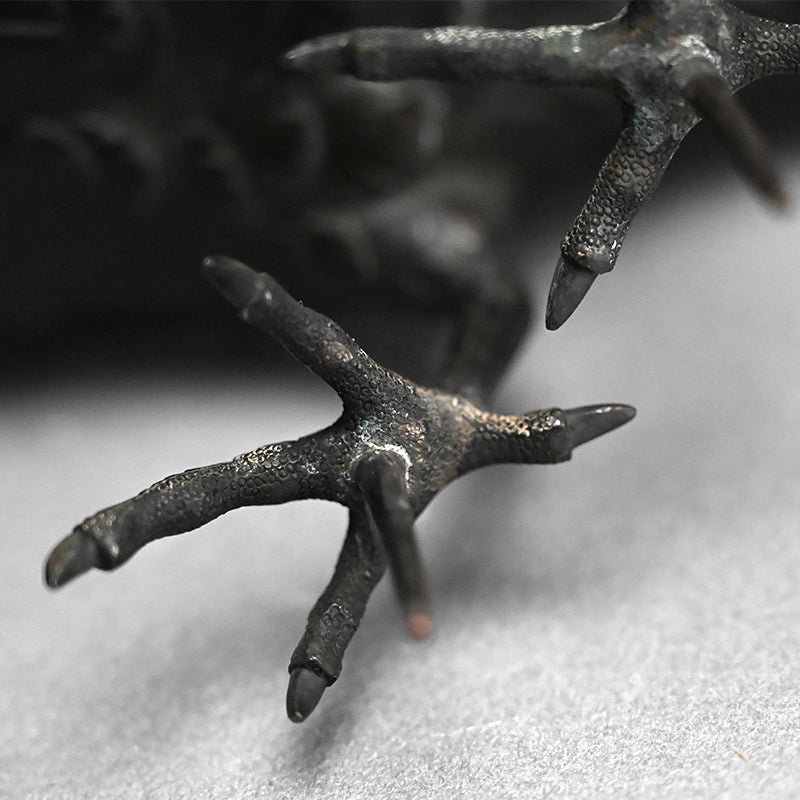
A bronze crow perched on a stone, alert, golden eyes gleaming, a rare motif in this Meiji period bronze okimono figure. Assembled on the stone the figure is 25 x 10 x 26 cm (10 x 4 x 10-1/2 inches) and is in excellent condition.
Fine Meiji bronze animal okimono are among the greatest achievements of Japanese sculpture, yet they remain undervalued relative to their artistic importance. Recent scholarship is beginning to challenge the old distinction between "craft" and "sculpture," recognizing that many Meiji okimono deserve to be studied as major works of sculpture rather than merely decorative export objects. f you examine the work of the best artists, especially those from the Kyoto and Tokyo bronze traditions, you see an astonishing synthesis of traditions. The sculptors inherited the observational realism of Buddhist sculpture, the technical sophistication of sword-fittings, centuries of lost-wax casting techniques, naturalistic study inspired by Maruyama-Shijō painting as well as an increasing awareness of European academic sculpture. However, unlike many European bronze sculptors, these artists often focused not on grand heroic narratives but on a single, perfectly observed moment. A crow ruffles its feathers. A crab braces itself against a wave. A tiger pauses before taking another step. These are sculptures about life itself, the moment, rather than drama. Their greatest achievement is not technical virtuosity, although that is remarkable. It is observation. The best sculptors never caricature an animal. They seem to understand its character. A monkey is mischievous without becoming comic. A tiger is powerful without becoming theatrical. A crow is intelligent rather than sinister. That sensitivity feels deeply connected to the broader Japanese artistic tradition, where painters from Maruyama Okyo to Nishimuira Goun sought not simply to depict an animal's appearance but to convey its living presence.