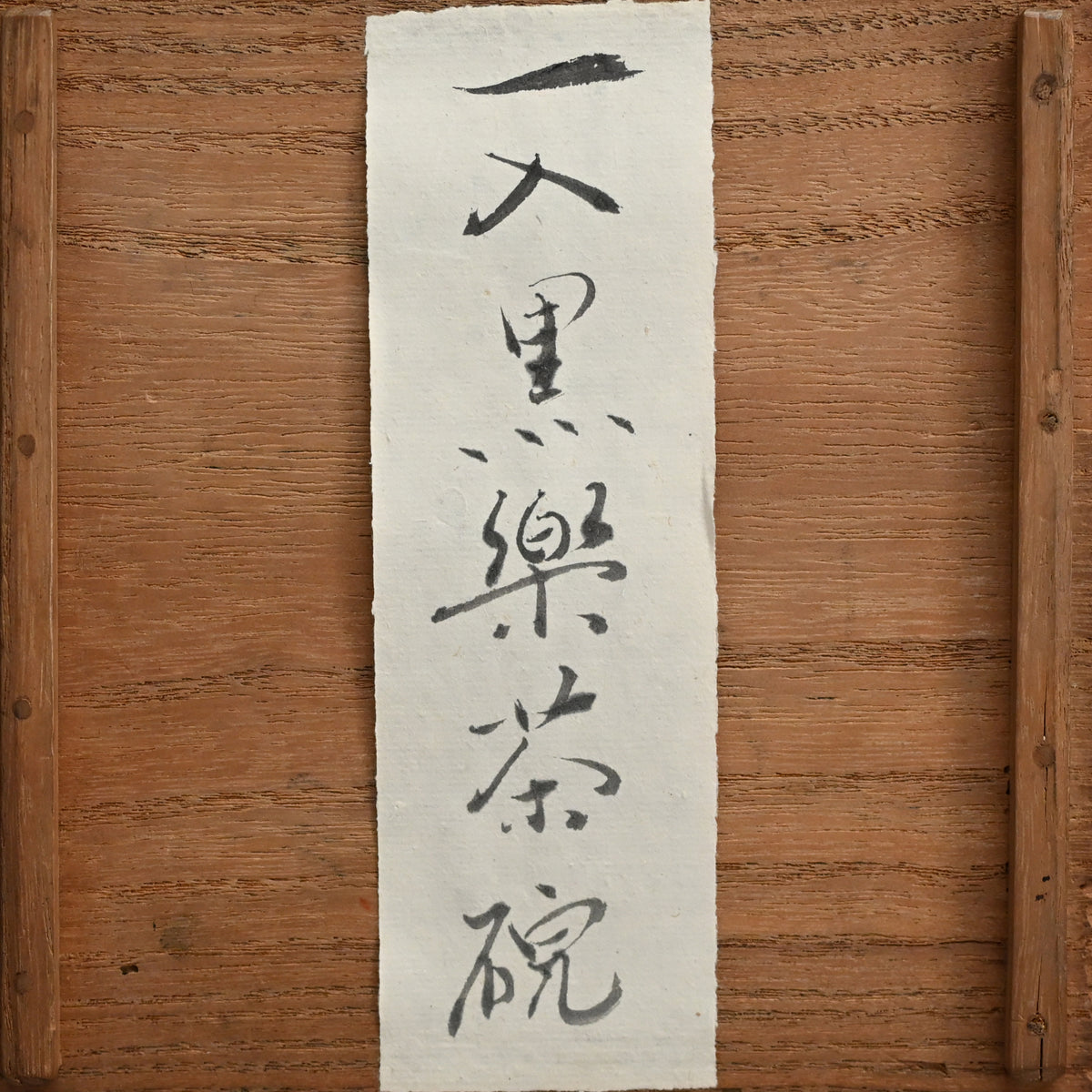
An Edo period black glazed Raku tea bowl enclosed in a period kiri-wood box aged to a rich auburn color upon the cover of which is written in lacquer Sonyu Kuro Chawan. Inside the lid is written Ichinyu Kuro Raku Chawan on a slip of paper. The Raku style is characterized by hand-molded rather than wheel-thrown pottery, emphasizing simplicity, naturalness, and a connection to the wabi-sabi aesthetic. With its characteristic matt black glaze, this bowl has a quietude reminiscent of the work of the first generation Raku Chojiro (died 1589). It is 12 cm (5 inches) diameter, 8 cm 3-1/4 inches) tall and in excellent condition.
The earliest Raku bowls were created in Kyoto in the late sixteenth century by Chōjirō, closely associated with the tea master Sen no Rikyū. Rather than adapting an existing utilitarian ceramic tradition to tea, the Raku bowl was essentially created for chanoyu itself. Raku bowls were hand-built rather than thrown on the wheel. They are intimate, relatively soft, restrained objects intended to be held closely in two hands. Chōjirō's great black bowls can be astonishingly austere: decoration disappears and even the potter's virtuosity seems deliberately suppressed. In this sense Raku embodies one aspect of Rikyū's tea extraordinarily well: the removal of everything unnecessary. The bowl becomes clay, glaze, tea and hands. There is an old tea-world expression that captures the hierarchy traditionally accorded to three great types of tea bowl: Ichi Raku, ni Hagi, san Karatsu. “First Raku, second Hagi, third Karatsu.” The saying should not really be understood as a modern ranking of artistic quality. Rather, it reflects how deeply Raku, Hagi, and Karatsu became identified with the aesthetics and practice of chanoyu, each offering a different tactile and visual experience. There is something else behind the old saying that I think is useful when discussing these bowls with collectors. None of the three depends primarily upon pictorial decoration or expensive material. Their value lies in experience. A Raku bowl asks to be held. A Hagi bowl asks to be used. A Karatsu bowl asks to be examined and turned in the hands. All three therefore make particularly little sense behind glass. Their weight, lip, foot, warmth, texture and relationship to the hands are essential to understanding them. That may explain why generations of tea practitioners placed these apparently modest ceramics above technically more spectacular porcelain. In chanoyu, the finest bowl was not necessarily the most perfect object. It was the object capable of creating the richest encounter between clay, tea, hand and time.
Raku Ichinyu (1662–1716) was a prominent Japanese potter who played a significant role in the development of the Raku ware tradition. He was the fourth-generation head of the Raku family, a lineage of potters renowned for their association with the Japanese tea ceremony. Raku Sonyu was born a son of Kariganeya San'emon and married Myozu, the daughter of Ichuinyu, becoming adopted into the Raku family. He succeeded as the 5th generation in 1691. In 1708 he took the tonsure, assuming the retiring name of Sônyû. His real father, Kariganeya San'emon was the youngest brother of Ogata Soken, whose sons, Ogata Kôrin and Kenzan, were his cousins. Kôrin and Kenzan formed a unique, highly decorative style of paintings and ceramics called the “Rimpa School” during the Genroku period that reached the height of social and political stability. Nonetheless, Sônyû pursued his creative inspiration more in the simplistic, non-decorative tea bowls of the Raku founder Chojiro in his effort of establishing his own style. His dry, matt black glaze, commonly known as kase glaze, is a proof of Sônyû's inclination for the style of Chojiro.