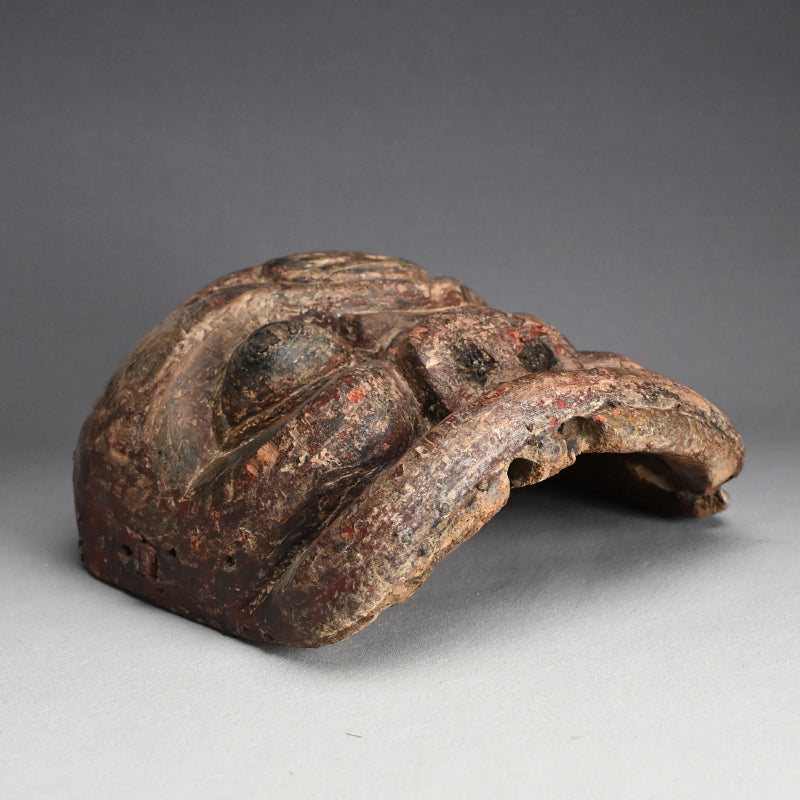
A large archaic mask of Enma, the Judge and King of Hell with the character King typically fashioned into a disk between the arches in his furled brow. This is from Northern Japan, the Tohoku region where the earlier Jomon culture, and the animistic cultures of the Ainu and Emishi blended with later Yamato court traditions and trade with Ezo (Hokkaido) and Sakhalin created a unique heritage. This appears to be roughly carved from paulownia wood, very lite, and was meant to be hung as a talisman to ward off evil and evil doers. It is 35.5 x 17.5 x 35 cm (14 x 7 x 14 inches) and dating from the Muromachi period (14th – 16th centuries).
Enma Daiō “Great King Enma” is the formidable judge of the dead in Japanese Buddhist tradition, popularly described as the King of Hell. But that English description is slightly misleading: Enma is not the Japanese equivalent of Satan or the embodiment of evil. He is essentially a magistrate of the afterlife, charged with judging the deeds of the deceased and determining their subsequent fate. Enma has an extraordinarily long history. His origins lie with Yama, an ancient Indian deity associated with death and the realm of the dead. With the development of Buddhism, Yama became increasingly associated with judgment after death. As Buddhism traveled through Central Asia into China, Yama became Yanluo Wang, a ruler and judge within an increasingly elaborate bureaucracy of the underworld. That conception subsequently entered Japan, where he became Enma Daio. The Japanese Buddhist underworld was therefore imagined rather like an earthly government: there were courts, judges, clerks, records, punishments and officials. Enma presided over this terrifying administration. Although he looks terrifying, Enma represents justice rather than malevolence. His frightening appearance expresses the inevitability of karmic consequence. You cannot bribe him, deceive him or conceal your previous conduct. Enma is usually depicted as a stern bureaucratic ruler rather than a demon. He wears the robes and headgear of a Chinese magistrate or king, sits behind a judgment desk, and often has an enormous red face, bulging eyes and furious expression. In Buddhist terms, moreover, Enma does not arbitrarily condemn someone. A person's own karma determines the consequences. Enma effectively reveals and administers them. There is therefore a moral message behind his terrifying face: actions have consequences.