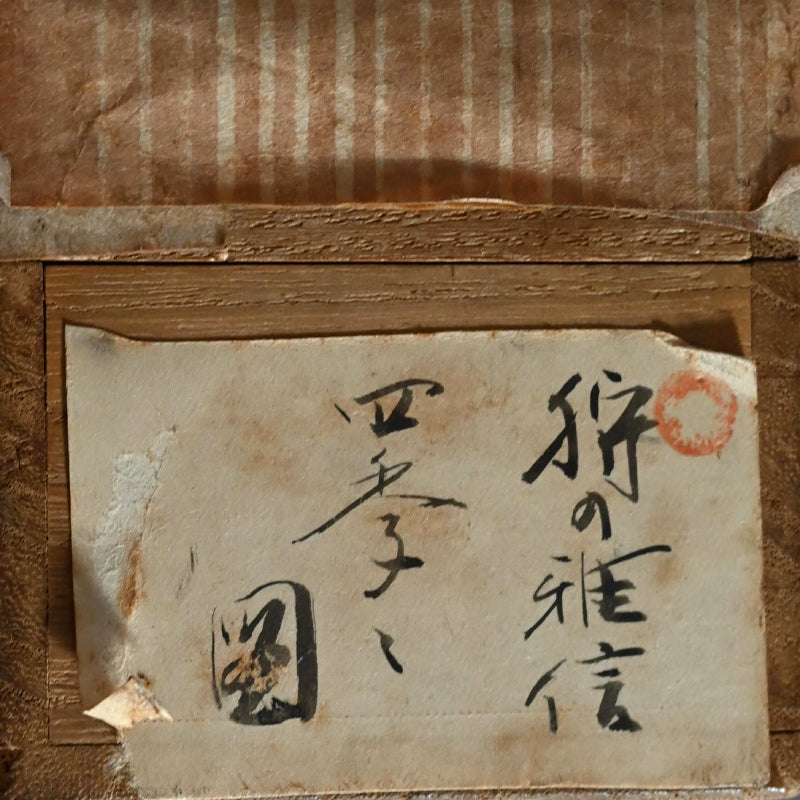
A delicate depiction of 4 small landscapes depicting the seasons by Kano Shosenin Tadanobu enclosed in a wooden box titled Shiki Sanzui no Zu decorated with seasonal flowers and annotated by Sakai Hoetsu. Pigment on silk in a fine silk border with red lacquered wooden rollers. The scroll is 65 x 215 cm (26 x 84-1/2 inches) and is in excellent condition completely restored in fine silk mounting.
Kano Shosenin Tadanobu (1823 – 1879) was a leading painter of the Kobikichō branch of the Kano school, active during the final years of the Edo period and into the Meiji Restoration. Born the eldest son of Kano Osanobu, he bore the childhood name Eijirō and later used the art names Katsukawa, Shōkawa-in, Soshōsai, and Shōko. Trained by his father, he entered official service in 1837, participating the following year in the production of wall paintings for the Nishi-no-Maru Palace at Edo Castle. From 1844 to 1845 he played a central role in the decoration of the Honmaru Palace, an achievement for which he was granted the title of Hōgen. Following his father’s death in 1846 he succeeded as the tenth head of the Kobikichō Kano family. He later directed large-scale projects for Edo Castle, including the Nishi-no-Maru Palace in 1852, and was elevated to the rank of Hōin in 1860. His distinguished career as an official painter was disrupted by the dissolution of the Edo Kano school after the Meiji Restoration. The family estate was confiscated in 1872, and he subsequently resided with his wife’s family. In the later 1870s he held administrative posts with the bureau of the United States Exposition, the Domestic Industrial Exposition, and finally the Ministry of Finance in 1879. Among his pupils were several artists who became central to the development of modern Japanese painting, including Kano Hōgai (1828–1888), Hashimoto Gahō (1835–1908), Kimura Ritsugaku (1828–1890), and Kano Akinobu (1840–1891), collectively celebrated as the “Four Heavenly Kings of Katsukawa.” Notable examples of his work include The Ten Ox-Herding Scenes (fusuma paintings in Daitoku-ji Temples, Dai’en’an), as well as works in the National Museum of Ethnology in Leiden, the Bauer Collection, The Shimonoseki City Art Museum, and Shizuoka Prefectural Museum of Art. A considerable number of works are also preserved in the Museum of Fine Arts, Boston. Recognized as the last great master of the Edo Kano school, his career illuminates the transition from the shogunal painting ateliers of the late Edo period to the evolving pictorial traditions of early Meiji Japan.