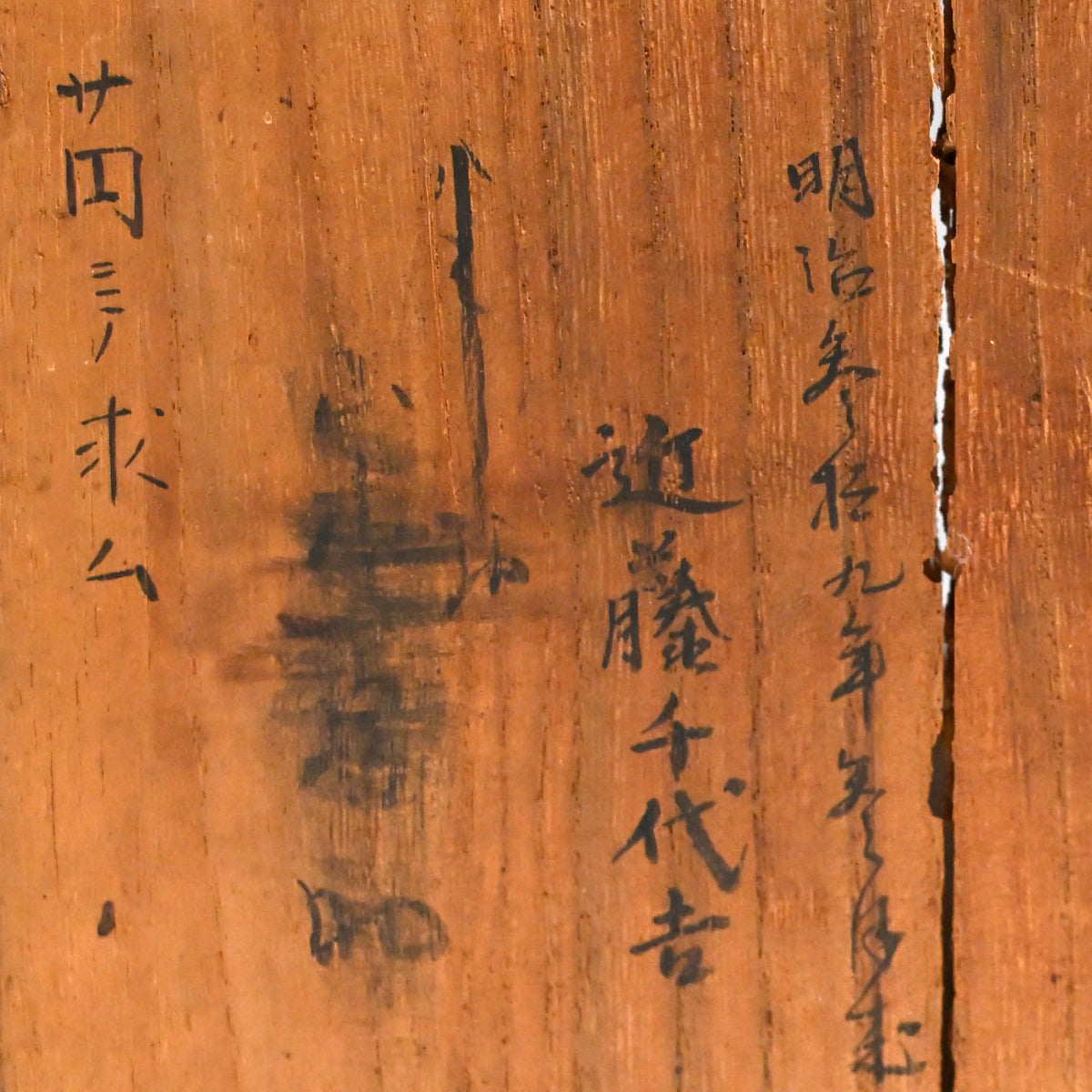
Blossoms burst open on scrolling vines with bamboo leaves in gold maki-e on the black lacquered surface of this unusual square food dish from the Toyoraku kiln of Nagoya enclosed in the original signed wooden box titled Kigu Utsushi Kakuju. Inside copper green glaze flows from the corners over crackled pale glaze decorated it traditional patterns in dark iron. It features a 2-piece tame-nuri (transparent red) lacquered lid decorated with the same scrolling vines as the outside of the ceramic box. This must have been a very special work, as it is not only in a wooden box signed and bearing the artists age, but engraved into the bottom of the piece itself is the same, highly unusual. It comes inside a silk lined cloth pouch in the original signed wooden box. It is 22.5 cm (9 inches) square, 9 cm (3-1/2 inches) tall and in excellent condition. The wooden box has some worm damage and is consistent with age.
The Toyoraku tradition began in the mid 1700s, however it was the fourth generation head of the household (Toyosuke IV 1813-1858) who moved the kiln to Kamimaezu in Nagoya and began applying lacquer and Maki-e to the works. He was succeeded by his son, Toyosuke V (d. 1885) who passed the kiln to his own son Toyosuke VI, (d. 1917), who was highly lauded in his lifetime and made pottery on order of the Meiji emperor, his pieces being selected for international exhibition. The family lineage ended in the Taisho period.
According to Yasuhiro Nakano, Assistant Director of the Aichi Prefectural Ceramic Museum: “Toyoraku ware is a soft pottery which was produced in Maezu in the southern part of Naka-ku, Nagoya City, Aichi Prefecture, for more than 130 years from the late Edo period to the Taisho era”. Also called "Horakuyaki", it is characterized by floral imagery with splashes of green copper glaze.