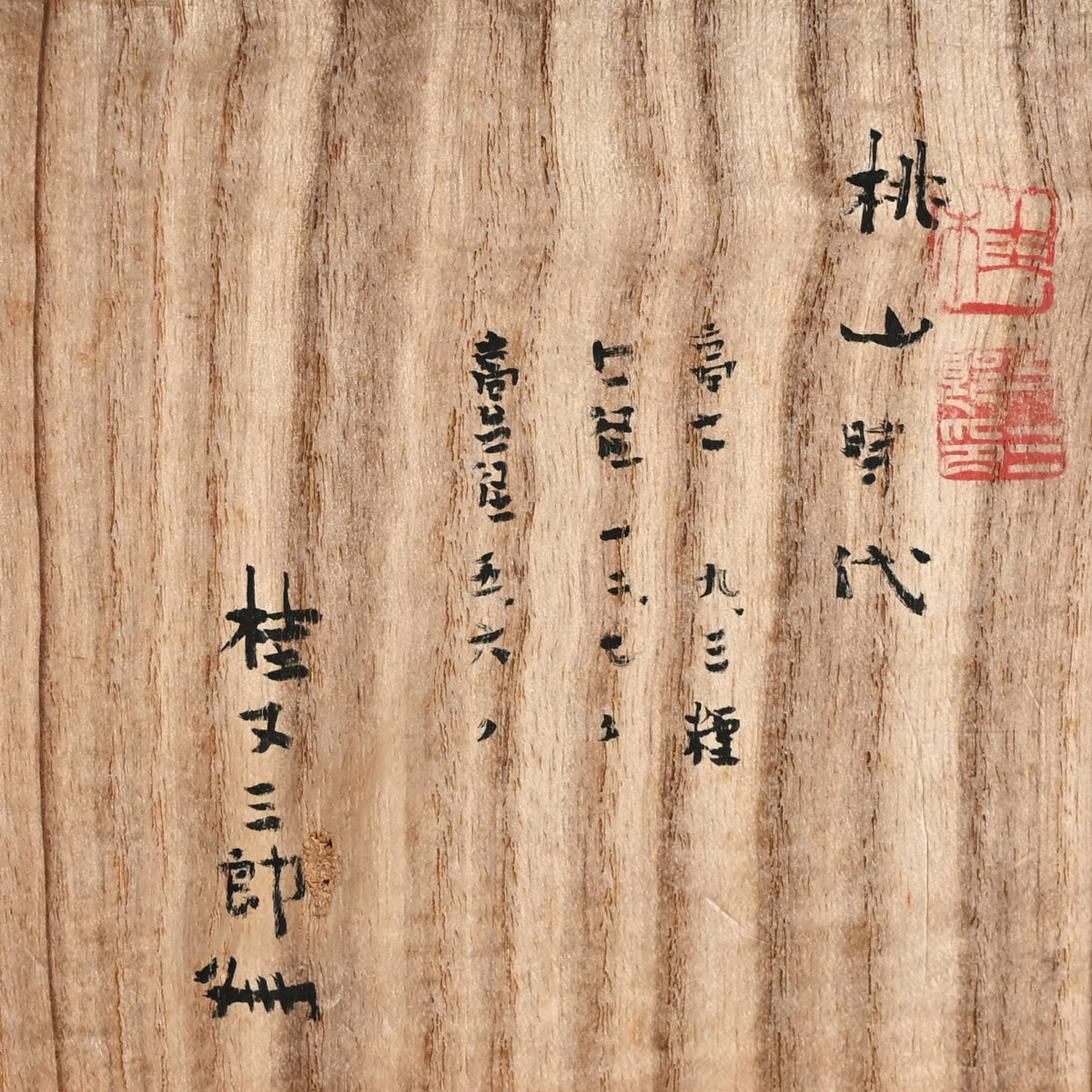
A haunting bowl on a tall foot covered in pale glaze with hazy Gohon spotting enclosed in a kiri-wood box titled Gohon Chawan annotated inside by the scholar Katsura Matasaburo which is in turn contained in an outer lacquered wooden protective box (Nijubako). Its softly irregular form retains the spontaneity associated with Korean ceramics while already reflecting the particular aesthetic preferences of Japanese tea practitioners. The warm, translucent glaze gathers unevenly across the body, punctuated by the characteristic fawn spots in soft gray. Rather than the deliberate refinement of contemporary Japanese tea ceramics, the bowl possesses an understated intimacy. It is 13 cm (5 inches) diameter, 9.5 cm (just less than 4 inches) tall. There are stable fine cracks running down from the rim and up from the foot testament of age and use. Inside the box lid is written Momoyama Jidai followed by dimensions and the signature and Kao of Katsura Matasaburo. I would date the bowl to the early Edo, likely manufactured in Japan.
Produced at the threshold between the Momoyama and early Edo periods, early Gohon chawan belong to an important moment in the relationship between Korean ceramics and Japanese tea culture. Earlier generations of tea practitioners had found unexpected beauty in Korean utilitarian wares, elevating bowls such as Ido and Kohiki into celebrated tea utensils. With Gohon, that relationship began to reverse: models and preferences originating within the Japanese tea world were communicated to Korean potters, who interpreted them through their own materials and methods. The resulting bowls are neither wholly Korean nor Japanese in conception, but products of a remarkable dialogue across the Korean Strait. Traditionally, Gohon wares are understood as Korean ceramics produced in response to Japanese orders or models sent to Korea, particularly for use in the tea ceremony.
Katsura Matasaburo (1901–1986) was a prominent Japanese researcher, folklorist, and leading authority on traditional Japanese ceramics, particularly renowned as a master expert and collector of antique Bizen ware. He developed a deep academic interest in regional folklore, ethnology, and local traditions. His historical and cultural inquiries naturally transitioned into a lifelong dedication to old Japanese pottery. He spent decades studying ancient kiln sites, excavating ruins, analyzing potting marks, and verifying antique pieces. He authored numerous scholarly books and articles, built an extensive private collection, and authenticated historical ceramics. He also mentored prominent modern ceramic artists, such as Harada Shuroku, who studied old Bizen techniques directly under him.