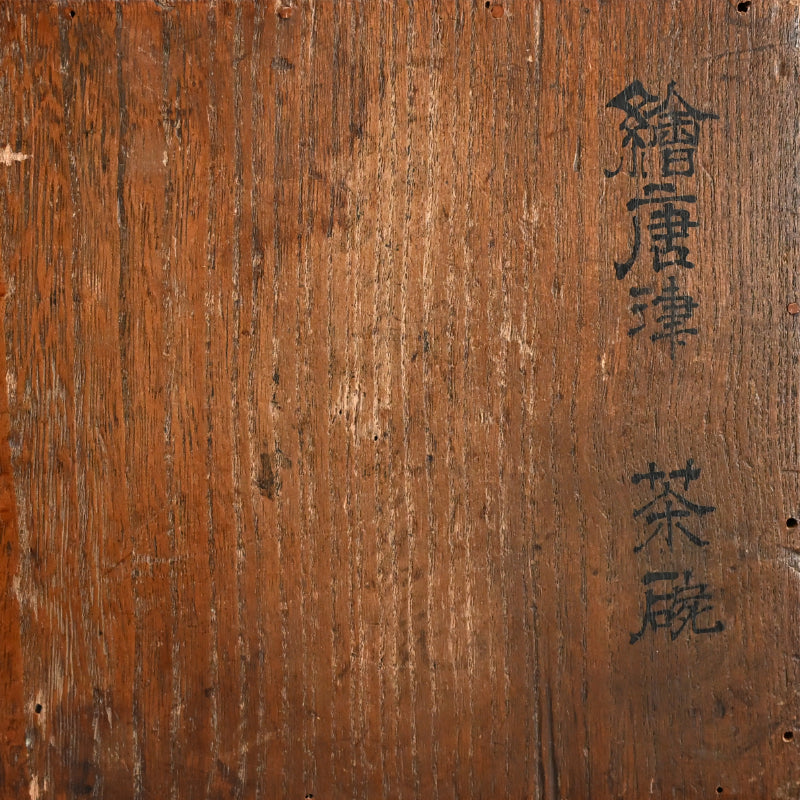
A Momoyama to Early Edo period large Karatsu Tea Bowl decorated with arabesque vine in iron over crackled gray wrapped in a padded silk pouch in a period kiri-wood box mellowed to dark auburn with age titled E-Karatsu Chawan. Interestingly, it is deeply pitted about the thin lip, evidence of the granular nature of the clay used in those early years. The bowl is 13.5 cm (5-1/2 inches) diameter, 8 cm (3-1/4 inches) tall and in excellent condition.
Karatsu occupies a particularly important position in Japanese tea culture. There is an old tea-world expression that captures the hierarchy traditionally accorded to three great types of tea bowl: Ichi Raku, ni Hagi, san Karatsu or “First Raku, second Hagi, third Karatsu.” The saying should not really be understood as a modern ranking of artistic quality. Rather, it reflects how deeply Raku, Hagi, and Karatsu became identified with the aesthetics and practice of chanoyu, each offering a different tactile and visual experience. Karatsu is particularly interesting because, unlike Raku, it did not originate primarily as a specialized tea ware. Tea practitioners discovered extraordinary beauty in vessels emerging from a much broader ceramic tradition. Karatsu ware developed in northern Kyushu, particularly around present-day Saga Prefecture, from the late sixteenth century. Its development was profoundly influenced by Korean ceramic technology. Korean potters introduced or developed techniques involving the kick wheel, climbing kilns, iron decoration and glazed stoneware production that transformed ceramics in the region. Early Karatsu was fundamentally utilitarian pottery—bowls, dishes and vessels made for everyday life. That origin is crucial to its character. Tea masters of the Momoyama and early Edo periods were increasingly drawn to objects possessing qualities of wabi: understatement, irregularity, naturalness and evidence of the maker's hand. Karatsu offered these almost effortlessly. Its beauty was not necessarily created by deliberately making something “rustic.” It arose naturally from clay, glaze, fire and rapid production. A Karatsu chawan can therefore possess a remarkable lack of self-consciousness. The foot may be roughly trimmed, the body slightly asymmetric, the glaze uneven or pooled, and the surface marked by firing. These characteristics became virtues in the tea room. Where Raku can be introspective and Hagi sensuous and evolving, Karatsu often feels earthy, spontaneous and remarkably direct. The clay itself is strongly present. Glazes may be thin and translucent, allowing the body beneath to remain visible. Iron brushwork may consist of only a few rapidly executed grasses, plants or abstract strokes. Ash and flame may alter the surface unpredictably. Even the famous E-Karatsu decorated wares demonstrate this restraint. A painter might suggest a plant with only three or four strokes. There is no attempt to fill the surface. That empty space became enormously sympathetic to the aesthetics of tea. A fine old Karatsu bowl can initially seem less precious than many celebrated Japanese ceramics. It may be rough. The glaze may stop irregularly above the foot. The foot itself can appear almost casually carved. There may be kiln scars, distortions or areas where flame has altered the glaze. But these are precisely the qualities that invite prolonged looking. The tea practitioner turns the bowl before drinking. The landscape changes: glaze thickens and thins; iron emerges beneath it; clay appears at the foot; perhaps one side has been transformed by the fire.