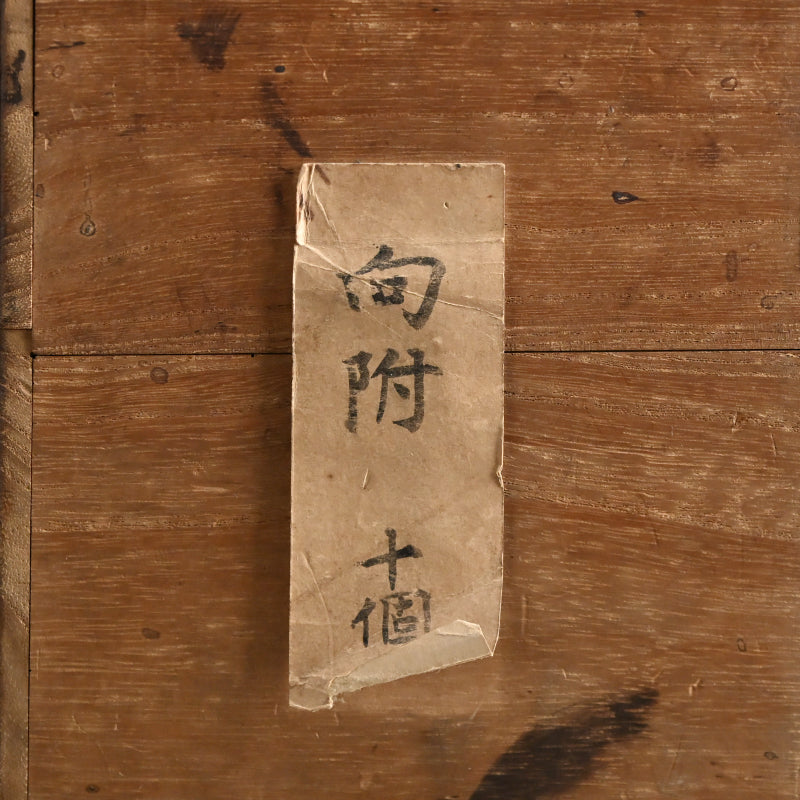
A set of 10 plates each uniquely decorated by Eiraku Zengoro XII (Wazen) enclosed in the original signed wooden box titled simply Mukozuke Juko (10 dishes). Each dish is 13 x 13 x 4 cm (5-1/4 x 5-1/4 x 1-1/2 inches) and are in excellent condition.
The Eiraku (Nishimura) family is one of Japan’s most important and historically significant lines of pottery artists in Kyoto, tracing back to the 16th century. The skill of Eiraku potters earned the honorific title of Senke-Jissoku, reserved for 10 families of artisans who produce tea ceremony utensils for the san-Senke, or Japanese tea schools. Eiraku Zengoro XII (Wazen, 1823-1896) was one of the most influential potters of his time, setting the stage for the revival of and modernization of Kyoyaki, based on models by Koetsu, Kenzan and Ninsei. Although named Sentaro, he was more commonly referred to by the name Zengoro, and used also the name Wazen after 1865. He was trained under his father, Hozen, who was a compatriot of Ninnami Dohachi and Aoki Mokubei, and rightfully one of the most famous potters of the later Edo. Wazen was given the reins to the family business quite early, in 1843, and managed the day to day running of the kiln while his father sought to perfect porcelain products in Kyoto. From 1852 to 1865 the family worked from a kiln at Ninnaji temple. Attracting the attention of a Daimyo from Kaga, from 1866-1870 he worked to revitalize a porcelain kiln in that area, coming to produce classic wares which are prized to this day. During this time of working divided from the family kiln, two workers who had been trained by his father shared the title of the 13th generation leader in Kyoto, however Wazen outlived both by decades. He returned to Kyoto in 1870, and also established a kiln in Mikawa in the 1870s to produce more common tableware. From 1882 until his death, it seems he worked from a large kiln in the Eastern Hills of Kyoto. Under both the 11th and 12 generations of this family the name Zengoro took on a life of its own, and came to symbolize the highest in porcelain and tea wares.