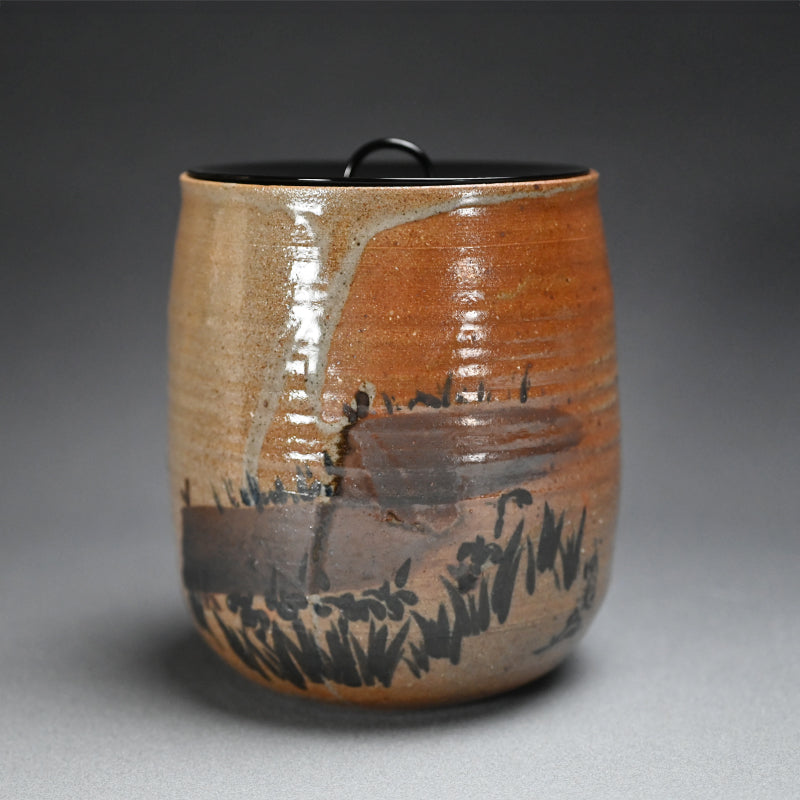
Yatsuhashi (8 bridges) Mizusashi from the Suiogi Kiln of Kobori Sokei
Yatsuhashi (8 bridges) Mizusashi from the Suiogi Kiln of Kobori Sokei
Item Code: K809
受取状況を読み込めませんでした
A fine Mizusashi fresh water jar for use in the Japanese Maccha Tea Ceremony by Kobori Sokei, 12th head of the Kobori line of tea masters fired at the kiln located on the grounds of the Kobori residence enclosed in a superb box annotated inside the lid by Kobori Sokei with the kiln name Mizuogi-Gama dated 1974. A sedate clay body rising up majestically under thin transparent glaze decorated with an image of iris growing around a plank bridge in reference to the 8 bridges story from the Ise Monogatari. To the right is the signature of Kobori Sokei and the name of his tea room Joshuan. It comes with a custom made black lacquered Tsukui-buta (concave) lid. The jar is 15 cm (6 inches) diameter, 16.5 cm (6-1/2 inches) tall and is in perfect condition.
Kobori Sokei was born on January 14, 1923 as the eldest son of Kobori Sōmei, the 11th head of the Enshu school of tea. While studying at the Tokyo School of Fine Arts (now Tokyo University of the Arts), he was mobilized for military service and sent to Manchuria as part of the student conscription program. After the end of the war, he endured four years of internment in Siberia. He was repatriated in September 1949, and the following year, in 1950 he received the tea name Sokei, and from that time forward, he devoted himself to the advancement of the tea world. In 1962 he succeeded as the 12th head of the Enshu school. Engaging not only in research into the fundamental principles of chanoyu but also in guidance in architecture and garden design, as well as broad activity across the fields of art and craft, he was especially renowned for his scholarship on celebrated textiles (meibutsu-gire), and was regarded as unsurpassed in his knowledge of tea flowers. In October 1992 he received the Tokyo Governor’s Award in recognition of his long-standing contributions to culture. The following year, in 1993 he was awarded the Order of the Rising Sun, Gold and Silver Rays.
The Mizuogi Kiln was a private household kiln located within the residence of the Enshu tea-ceremony lineage during the period when its headquarters were in Aoyama. The Joshuan was a tea room belonging to the head family of the Enshu school of tea, founded by the early Edo-period tea master Kobori Enshu. The name Jōshū-an derives from a letter by Enshu containing the phrase, “The red plum of Joshu-an is half in bloom.” Although there was once a tea room of the same name at Enshu’s Fushimi residence, the present structure is not considered a direct inheritance of that earlier design. Although its original appearance is no longer known, the present structure was relocated in 1961 to the Enshu school head family’s grounds in Shinjuku, Tokyo. It is attributed to the Sukiya master carpenter Kimura Seibei.
The “Eight Bridges” (Yatsuhashi) episode is one of the most celebrated passages in the classical literary work The Tales of Ise (Ise Monogatari), and it has resonated for centuries in poetry, painting, and the tea ceremony. While traveling eastward through Mikawa Province, the unnamed protagonist—traditionally identified with the court poet Ariwara no Narihira—comes upon a marsh thick with blooming Kakitsubata (irises). To cross the wetland, eight narrow bridges have been laid in a zigzag pattern. Moved by the scene, the travelers compose poetry. The protagonist writes a waka in which each line begins with a successive syllable spelling kakitsubata.
Iris flowers wrapped in the sleeves of a traveler’s robe;
thinking of my distant wife, I realize how far I have come.
The poem links place, season, and emotional distance, blending physical travel with longing for the capital and for a loved one left behind. The Eight Bridges episode is not about geography alone—it is about distance felt, beauty encountered briefly, and the way poetry transforms a moment in nature into lasting cultural memory. That quiet crossing over water and flowers becomes, in Japanese aesthetics, a lifelong metaphor. In tea culture, Yatsuhashi evokes cultivated melancholy (mono no aware), travel, and poetic memory. The theme is often chosen for early summer gatherings
共有