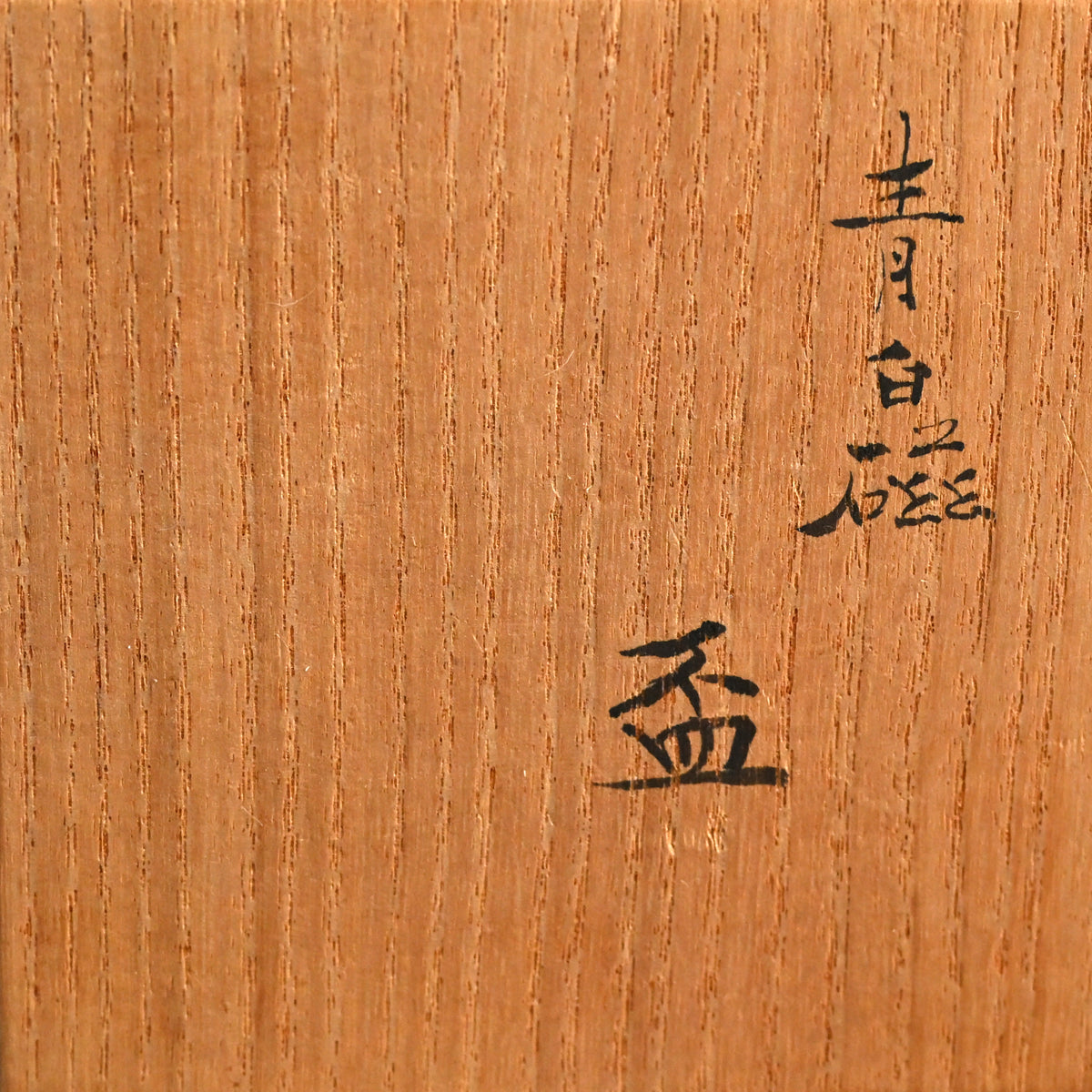
A luminous seihakuji porcelain sake cup by Living National Treasure Tsukamoto Kaiji enclosed in the original signed wooden box titled Seihakuji Hai (Bluish-White Porcelain Sake Cup). The exceptionally thinly potted body rises from a small, neatly defined foot, swelling gently outward before drawing inward almost imperceptibly toward the lip. Its apparent simplicity depends upon extraordinary control of both porcelain and glaze. A nearly colorless translucent glaze covers the softly white body, taking on the faintest blue-green cast where it gathers within the cup, while around the foot the glaze deepens dramatically into a clear pool of pale turquoise. Under changing light the vessel seems to shift between pure white, ice blue and the delicate blue-green for which seihakuji is celebrated. The thin walls and restrained profile give the cup an almost weightless quality, recalling the refined porcelains of the Chinese Song dynasty that Tsukamoto studied throughout his career, yet the form remains unmistakably his own in its quiet modern precision. Particularly beautiful is the relationship between the luminous white bowl and concentrated band of blue surrounding the foot, as though the color has settled naturally to the lowest point of the vessel. Devoid of decoration, the cup relies entirely upon proportion, translucency, surface and the subtle movement of glaze for its effect—an exquisite example of Tsukamoto's ability to find remarkable richness within extreme restraint. It measures 6.2 x 5.2 cm (2-7/16 x 2-1/16 inches) diameter and 4.5 cm (1-3/4 inches) tall, in excellent condition.
Tsukamoto Kaiji (1912-1990) devoted much of his career to the study and revival of the great white and bluish-white porcelain traditions associated particularly with Chinese Song dynasty ceramics. Working in his native Gifu Prefecture, he developed an intensely refined approach to hakuji and seihakuji, pursuing purity of form and the subtle blue-green translucency produced where glaze gathers over a white porcelain body. His work received increasing national and international recognition during the postwar decades, including a Gold Medal at the 1964 New York World's Fair, awards at the Japan Traditional Art Crafts Exhibition, and the Japan Ceramic Society Award in 1979. In 1983 Tsukamoto was designated a Holder of Important Intangible Cultural Property—popularly known as a Living National Treasure—for his mastery of seihakuji porcelain. His works are held in major Japanese museum collections, including the National Museum of Modern Art, Tokyo; the National Museum of Modern Art, Kyoto; the Museum of Oriental Ceramics, Osaka; and the Aichi Prefectural Ceramic Museum. Through vessels of remarkable technical refinement and restraint, Tsukamoto transformed his deep engagement with classical Chinese porcelain into a distinctly modern Japanese expression.