Imitating Life, a Rare Raw Clay Vase by LNT ー清水 卯一 “素地釉 花瓶”
Item Code: MC1489
受取状況を読み込めませんでした
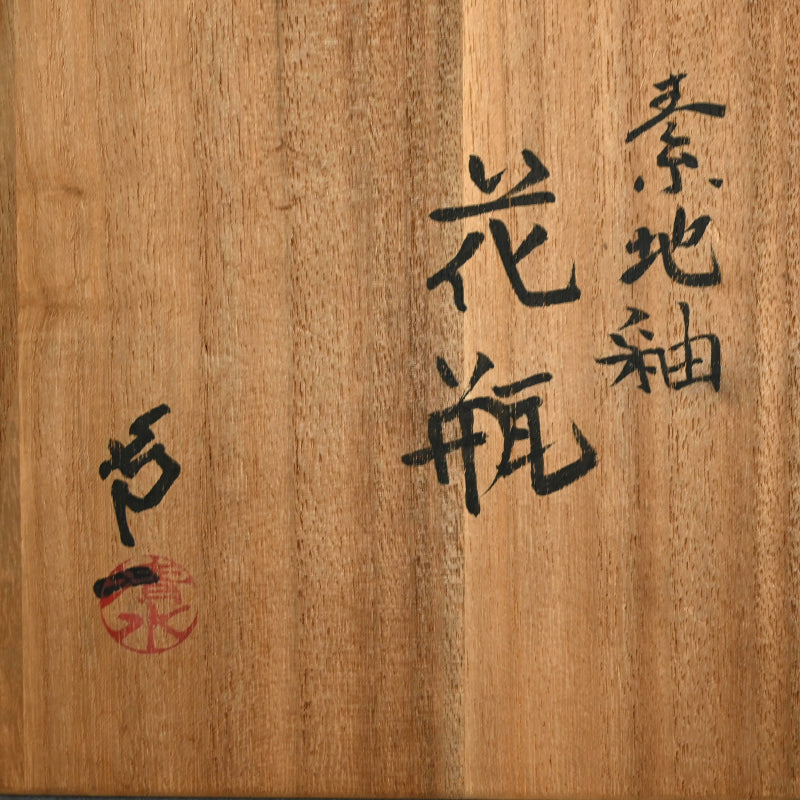
A haunting experimental work in cracked raw clay by Living National Treasure Shimizu Uichi enclosed in the original signed wooden box titled Sojiyu Kabin. In pottery "soji-yu" refers to a glaze that is designed to highlight, mimic, or blend with the raw texture of the underlying clay body, often resulting in a matte, natural, or tactile finish. Across the rounded body, the coating shifts from powdery softness to pronounced fissures resembling parched ground, old plaster or weathered stone. Rather than using glaze to conceal the clay beneath, Shimizu allows it to preserve—and even exaggerate—the material character of the vessel. The result is strangely ancient in appearance, as though shaped not only by the potter and kiln but by a much longer process of erosion and time. Among Shimizu's many investigations into glaze, Soji-yū represents an unusually quiet experiment: not a search for greater color or brilliance, but an attempt to discover how close a fired surface might remain to earth itself. This vase is 17 cm (6-3/4 inches) diameter, 23 cm (9 inches) tall and is in perfect condition.
This is remarkably unlike the polished image most people associate with Shimizu Uichi, and for precisely that reason I think it deserves an important place in Muchū. What fascinates me is the degree to which he has made surface and substance almost indistinguishable. The form itself could hardly be simpler: a swollen, nearly spherical body rising abruptly into a short cylindrical neck. There is something almost archaeological about it—one could imagine it excavated rather than newly made. The result resembles parched earth, weathered plaster, old bone, or stone exposed for centuries. And this is where I think soji-yū becomes particularly interesting. A conventional glaze establishes a distinction: clay beneath, glaze above. Here Shimizu seems to be deliberately collapsing that distinction. The glaze does not beautify or conceal the body. It appears almost to become the body. From a distance one might reasonably believe that one was looking directly at dry, unfired clay.
Shimizu Uichi (1926-2004) was born in Kyoto the son of a ceramic dealer. Discarding the family business, he apprenticed in plastic arts under future Living National Treasure Ishiguro Munemaro. His work retains some principal elements of his teachers style while incorporating an understated elegance and avant-garde spirit of challenge uncommon for his time. He was first exhibited at the Nitten in 1951, receiving numerous awards there since. He also took the gold medal at the Prague International Exhibition, and was at the Brussels World Exposition. He is in the collection of the Tokyo National Museum, Kyoto Museum of Modern art, Clark Center and the Freer Gallery among many others.
共有