Hakuzosu Fox in Priest Robes ー大田垣 蓮月 "白蔵主"
Item Code: Z128
受取状況を読み込めませんでした
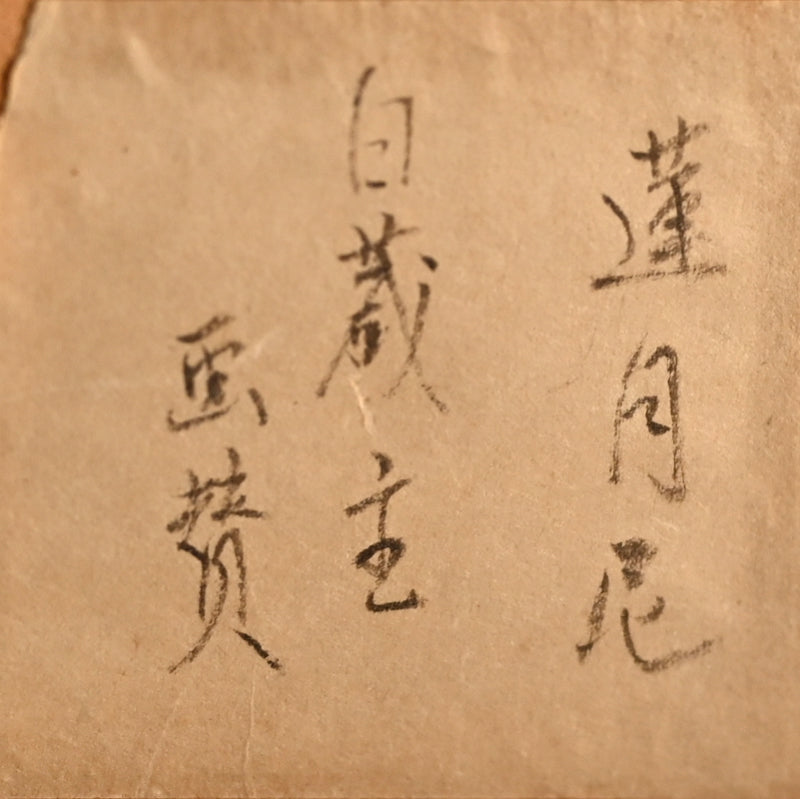
The ethereal fox appears in the mist dressed in the robes of a wandering Buddhist, the wispy characters of a poem by Otagaki Rengetsu draped around like rain. The poem reads:
Hito hakaru Tricking people
Sagano no hara no as is his nature
Yuumagure at twilight in these fields of Sagano...
ono ga obana ya is he displaying his tail
hana to misu ran. as if it were a plume of silver grass?
Ink on paper in a silk border the color of autumn grass terminating in black lacquered wooden rollers. The scroll comes enclosed in a wooden box signed by Tayama Honan at Jinkoin Temple. The scroll is 46.8 x 194.5 cm 18 x 76-1/2 inches) and is in overall fine condition, with some very faint foxing typical of age.
In Japanese folklore and performance, the figure of Hakuzosu occupies a liminal space between priestly authority and the cunning of the fox. Most famously preserved in kyogen plays such as Tsurigitsune (“The Fox Tricked”), Hakuzosu appears as a fox spirit assuming the guise of a venerable Buddhist abbot in order to dissuade a hunter from his pursuit. The transformation captures a central theme in Japanese art and literature: the porous boundary between the sacred and the profane, illusion and truth. Artists and dramatists alike drew upon Hakuzosu to explore both the humor and pathos of human credulity, while also invoking the fox’s longstanding associations with shapeshifting, deception, and divine messengers of the kami Inari. In painted scrolls, carved netsuke, and theatrical masks, the figure embodies a playful yet unsettling reminder that wisdom and trickery often share the same face.
Otagaki Rengetsu (1791-1875) was born into a samurai family, she was adopted into the Otagaki family soon after birth, and served as a lady in waiting in Kameoka Castle in her formative years, where she received an education worthy of a Lady of means. Reputed to be incredibly beautiful, she was married and bore three children; however, her husband and all children died before she was twenty. Remarried she bore another daughter, however that child too perished and her husband died while she was just 32. Inconsolable, she cut off her hair to join the nunnery at Chion-in Temple, where she renounced the world and received the name Rengetsu (Lotus Moon). However, this was not the end, but only the beginning of a career as artist and poet which would propel her to the top of the 19th century Japan literati art world.
Nobuo Tayama (art name: Honan (1903-1980), Specialist Member of the Council for the Protection of Cultural Properties, was born in Ayama District, Mie Prefecture, the eldest son of Kawai Shogin, abbot of Manzoji Temple. After graduating from Mie Prefectural Ueno Middle School in 1921, he was adopted as the heir of Tayama Yasokichi of Ueno City. In 1925 he entered the Department of National History, Faculty of Letters, Tokyo Imperial University, graduating in 1928. In August 1929 he was appointed Assistant Inspector of National Treasures in the Religious Affairs Bureau of the Ministry of Education, working on the survey and designation of National Treasures. In 1945 he became both a Historical Compilation Officer and National Treasure Inspector. After the war, he served in the Research Division of the National Museum and in the Fine Arts and Crafts Section of the Committee for the Protection of Cultural Properties, rising from Cultural Properties Investigator (specializing in calligraphic works) to Chief Investigator, devoting himself until his retirement in 1965 to the survey and designation of documentary and calligraphic heritage, including manuscripts, classical texts, sutra transcriptions, and Zen calligraphic works. After retirement he served as a member of the Council for Cultural Properties, later as Chair of the Calligraphy Division of the First Specialist Subcommittee of the Council for the Protection of Cultural Properties within the Agency for Cultural Affairs, as Director of the Matsunaga Memorial Museum in Odawara, Kanagawa Prefecture, and as a Trustee of the Meiji Village Museum Foundation. In his specialty, the study of Zen monastic calligraphy (zenrin bokuseki), he published several volumes, while also undertaking the classification and cataloguing of major collections, including the Yomei Bunko and the Otokyu Memorial Library, producing numerous scholarly annotations. His investigations extended widely to temple archives, religious texts, and complete Buddhist canons. His contributions to the preservation of calligraphic works, classical literature, and documentary heritage in Japan were of the highest importance. He was awarded the Order of the Sacred Treasure, Gold Rays with Neck Ribbon, in 1973.
Share