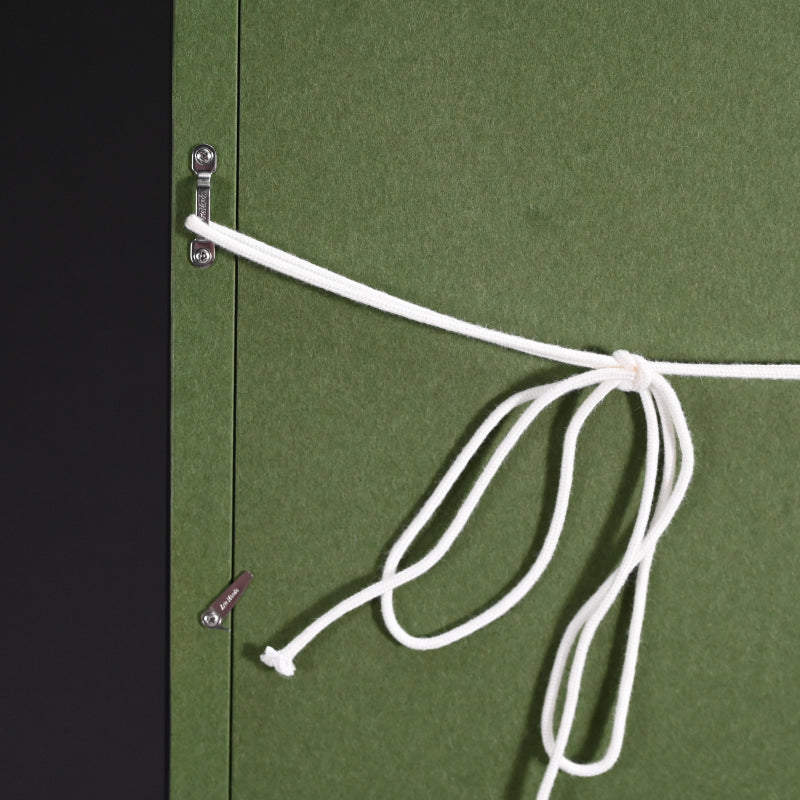
A frottage work by Nomura Ko mounted in a frame inscribed S59.1.2, (Jan. 2 1984) and signed K. Nomura. This work emerges from Nomura Kō’s sustained exploration of the frottage technique in which surfaces are rubbed to transfer their textures onto paper. Rather than depicting objects directly, the artist allows fragments of the physical world—textiles, carved patterns, architectural reliefs, printed matter, and organic textures—to imprint themselves through graphite and pigment. The resulting composition is not constructed in the traditional sense; it is revealed through accumulation. Color—primarily shifting bands of green, yellow, and muted violet—washes across the layered rubbings, binding disparate textures into a unified atmospheric field. Within this dense terrain, figurative elements gradually emerge: a robed standing figure near the center, a reclining nude along the lower edge, and ghostlike repetitions of bodies moving across the upper register. These figures do not dominate the composition but seem to surface momentarily from the surrounding textures, as if discovered within the material itself. Through frottage, Nomura relinquishes full authorial control, allowing the material world to participate directly in the act of image-making. The work becomes a site where chance, texture, and memory intersect, echoing the Surrealist pursuit of automatism while resonating with long-standing Japanese sensibilities that value the accidental trace and the revelation of hidden forms. Mixed media on paper, it is 44.5 x 59.5 cm (16 x 24 inches) and is in excellent condtion. The frame is 58.7 x 76.7 x 2.4 cm (23 x 30-1/2 x 1 inches). If shipped without the frame an appropriate discount will be offered.
Nomura Ko (1927–1991) was born in Kyoto and graduated from the Nihonga Department of Kyoto Municipal College of Art in 1948. In 1950 he joined the Pan Real Art Association (until 1965), establishing himself as a significant figure in the postwar avant-garde movement in Japanese-style painting. Initially influenced by Surrealism, he shifted in the later 1950s toward abstraction and collage, employing unconventional materials such as newspaper printing molds, industrial waste, slate, and cement. From the mid 60”s he was driven beyond the framework to be a pioneer in installation exhibition, creating one-time works which allowed the room to be the frame. Through materially driven works and these later three-dimensional and spatial constructions, Nomura fundamentally redefined the physical and conceptual boundaries of Nihonga. His major exhibition history includes the aforementioned Pan Real (1950-1965), the Asahi New Artist Exhibition, the Asahi Selected Exhibition and the Contemporary Japanese Art Exhibition. Trends in Contemporary Painting (1963), and Today’s Artists ’64 (1964). From 1978 onward, he participated almost annually in the Ge Exhibition. In 1986, he was featured in A Section of Postwar Nihonga at Yamaguchi Prefectural Art Museum. A major retrospective, Kyoto Art: Yesterday, Today, Tomorrow III – Nomura Ko, was held at Kyoto City Museum of Art in 1989. His work was posthumously included in The Turning Point of Postwar Nihonga at Tochigi Prefectural Museum of Fine Arts in 1993, confirming his pivotal role in transforming postwar Nihonga. Work by him is held in the collections of The Kyoto National Museum of Modern Art, Fukui Fine Arts Museum, Kariya City Art Museum, Kyoto City Kyocera Museum of Art, Meguro Museum of Art in Tokyo, Nara Prefectural Museum of Art, Osaka Nakanoshima Museum of Art, Osaka Prefectural 20th Century Art Collection, Tochigi Prefectural Museum of Art, Toyohashi City Museum of Art, Wakayama Museum of Modern Art, Yamaguchi Prefectural Art Museum, Sakuragaoka Museum, The, Kyoto University Art Museum and Kyoto City University of Arts among others.