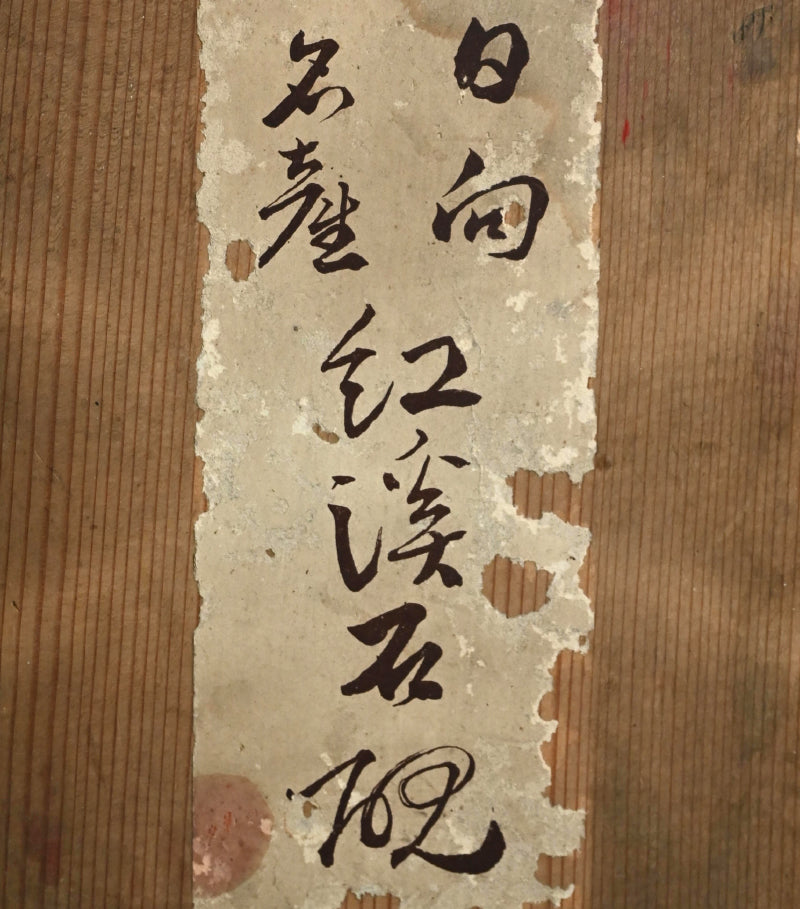
An unusual Ink stone (Suzuri Ishi) cur from fine red slate in the shape of a Chinese figure holding a broom and a scroll, an obvious nod to the endearing Zen figures of Kanzan and Jitoku (Hanshan and Shide). The blank of the scroll itself forms the ink well, a place to dip the brush before writing. On the back is written an inscription, to my mentor The Esteemed Mr. Kimura, from Tajiri Shusei. It comes in a wooden box titled Kokeiseki Suzuri. Kokeiseki is a stone from Miyazaki prefecture on the southernmost of the four main islands of the Japanese archipelago. The stone is 23 x 14.5 x 2 cm (roughly 9 x 6 x 1 inches) and is in excellent, unused condition.
Kanzan and Jitoku are a pair of legendary figures revered in Japanese Buddhism and popular lore as embodiments of enlightened eccentricity. They occupy a unique position at the intersection of Zen thought, poetry, and folk humor, representing wisdom that lies beyond social convention. They originated in Tang-dynasty China and entered Japan through Zen transmission. Kanzan is remembered as a reclusive poet-monk who lived in the mountains, composing verses that mixed Buddhist insight, Daoist naturalism, and sharp social critique. Jittoku, by contrast, was said to be a kitchen attendant at a monastery who gathered discarded food and scriptures. Despite their humble appearance and erratic behavior, both were believed to possess profound spiritual insight. The pair are typically portrayed as ragged, laughing figures,Kanzan Holding a scroll, and Jitoku a broom. Their laughter expresses awakening free from attachment, mocking rigid doctrine, hypocrisy, and worldly ambition. In Zen interpretation, they demonstrate that enlightenment does not depend on status, learning, or outward piety. In Japan—particularly from the Kamakura through Edo periods—Kanzan and Jittoku became beloved Zen icons. Monks, literati, and artists embraced them as anti-authoritarian saints, figures who revealed Buddhist truth through spontaneity rather than discipline alone. Their images were commonly displayed in Zen temples, tearooms, and scholars’ studios as reminders that true wisdom may appear foolish.