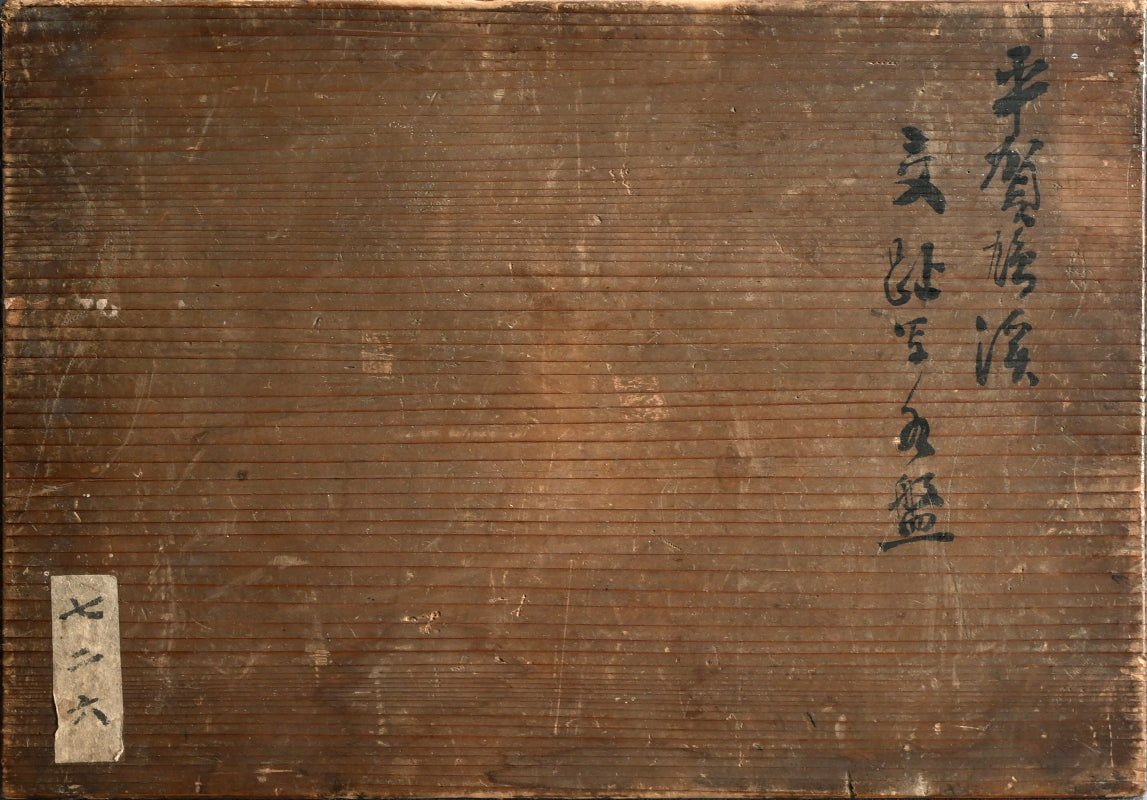
Hotei sleeps quietly against his bottomless sack of treasures on this Suiban basin by Hiraga Gennai enclosed in a period wooden box titled Hiraga Kyukei Kochi Itsushi Suiban. It is 35.5 x 24 x 6 cm (14 x 9-1/2 x 2-1/2 inches) and is in overall excellent condition.
Gennai Yaki, known for its bright coloring, originated during the Horeki era (1751 – 1764) in Shido, Sanuki Province (mod. Kagawa prefecture) when Hiraga Gennai (1728-1780) a scientist and intellectual developed a process based on the Cochin ware style of China. Gennai was typically decorated with bold designs with green and yellow glazes. The style was developed by Gennai, and the wares were produced mostly by his apprentice Wakita Gengo, who used the name of “Shunmin,” (resulting in another name for the pottery style, Shunmin-yaki). Yashima ware from the same area is a type of earthenware descending from Gennai ware.
Hiraga Gennai was a Japanese polymath and Rōnin (Masterless Samurai) of the later Edo period. His birth name was Shiraishi Kunitomo, but he later used numerous pen names. He is best known by the name Hiraga Gennai. He was a pharmacologist, student of Rangaku (Dutch studies), physician, author, painter and inventor well known for his Erekiteru (electrostatic generator), Kandankei (thermometer) and Kakanpu (asbestos cloth). Gennai composed several works of literature, including the fictional satires Fūryū Shidōken den (1763), the Nenashigusa (1763) and the Nenashigusa kohen (1768), as well as the satirical essays On Farting and A Lousy Journey of Love. He also authored two guidebooks on the male prostitutes of Japan, the Kiku no en (1764) and the San no asa (1768).