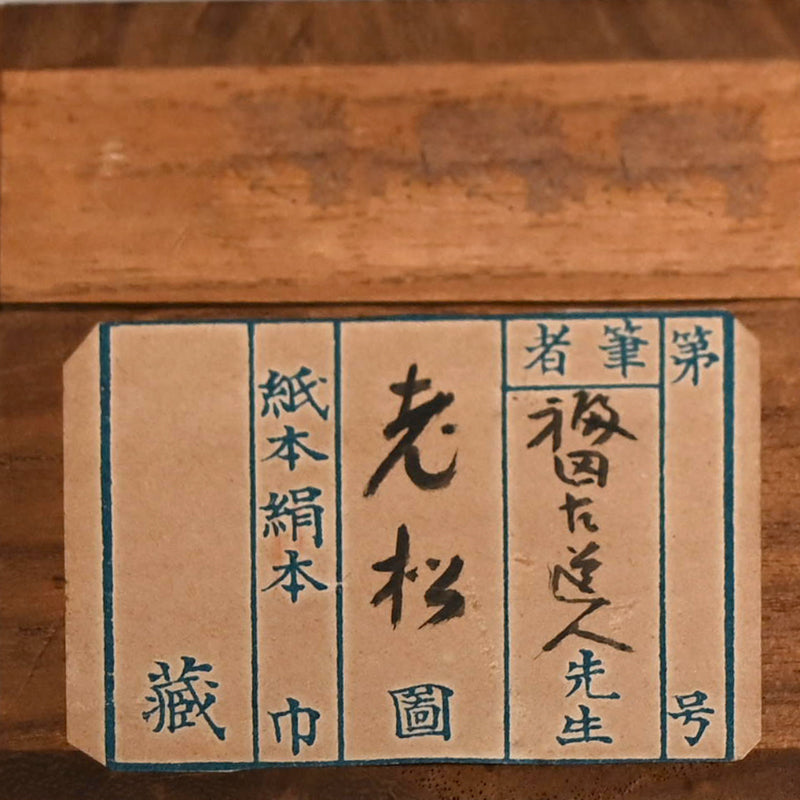
Ancient Pine Tree ー福田 古道人 “壱松図”
Item Code: 古51
受取状況を読み込めませんでした
This powerful hanging scroll by Fukuda Kodōjin (1865–1944) depicts an ancient pine tree, rendered with an intensity and abstraction that typify the painter’s most expressive ink work. Kodōjin dissolves the foliage into a dense, radiating mesh of pine needles, built from sharply angled, intersecting strokes. These needle clusters—at moments appearing like bursts of energy or ink “constellations”—convey both the vitality of the living tree and the spontaneous inner movement of the artist’s hand. The mass of the pine trunk anchors the composition, its gnarled surfaces suggested through broad washes, splashed ink, and unexpected reserves of untouched paper. Kodōjin allows his brush to wander freely: his hallmark of unpredictability. Dry strokes scrape across the paper, wet ink spreads into velvety blooms, and dark accents punctuate the bark like ancient scars. The result is not a naturalistic study but a lit¬erati meditation on the pine’s symbolic qualities: longevity, steadfastness, and the quiet strength of one who endures through seasons and years. Kodōjin’s inscription along the left margin, written in his distinctive wandering hand, ties poem and image together, a counterpoint to the painting’s erratic essence. ink on paper in a silk border with wood rollers enclosed in the original signed wooden box dated 1938 and titled Oimatsu Zu. The scroll is 47.5 x 202 cm (19 x 79-1/2 inches) and is in overall fine condition with minor marks typical of age.
Fukuda Kodojin (1865-1944) was an eccentric self-taught artist, his status as a poet, calligrapher and literati artist has reached legendary status. Born at a time of great change (4 years before the final fall of the Edo Government), he lived through the westernization of Meiji, Taisho Democracy, the rise of Imperialism and final defeat of the Showa eras. He was part of a small group of artists existing outside conventional circles in pre-war Japan. He moved to a village outside of Kyoto in 1901, where he supported himself and his family by privately tutoring those who wished to learn Chinese-style poetry. Kodojin was simply a scholar. His poetry, painting, and calligraphy all stem from a life-long cultivation of the mind. He was said to have taken the time just before his death to destroy the large portion of his own remaining work, leaving only that which must have met some personal criteria. Kodōjin’s paintings and calligraphy survive mainly in private collections, but significant works can be found in the collections of the British Museum, Freer Sackler Gallery of the Smithsonian Institute, Honolulu Museum of Art, Houston Museum of Fine Arts, Kumamoto Prefectural Museum of Art, Minneapolis Institute of Art, Museo Kaluz, New York Metropolitan Museum of Art, Portland Art Museum, Seattle Art Museum, St. Louis Art Museum, Tanabe City Museum of Art and Wakayama Prefectural Museum of Art among others including such well known Private collections as the Cowles Collection, Hakutakuan Collection, Manyoan Collection and Welch Collection. Twenty five paintings by the artist formed a private exhibition (from the Gitter-Yelen collection) at the New Orleans Museum of Art in 2000. In recent years, exhibitions such as The Last Master of the Literati Tradition: Fukuda Kodōjin (Minneapolis Institute of Art, 2023) have brought renewed attention to his achievement. For more on his life see the book Old Taoist, or Unexplored Avenues of Japanese Painting.
Share