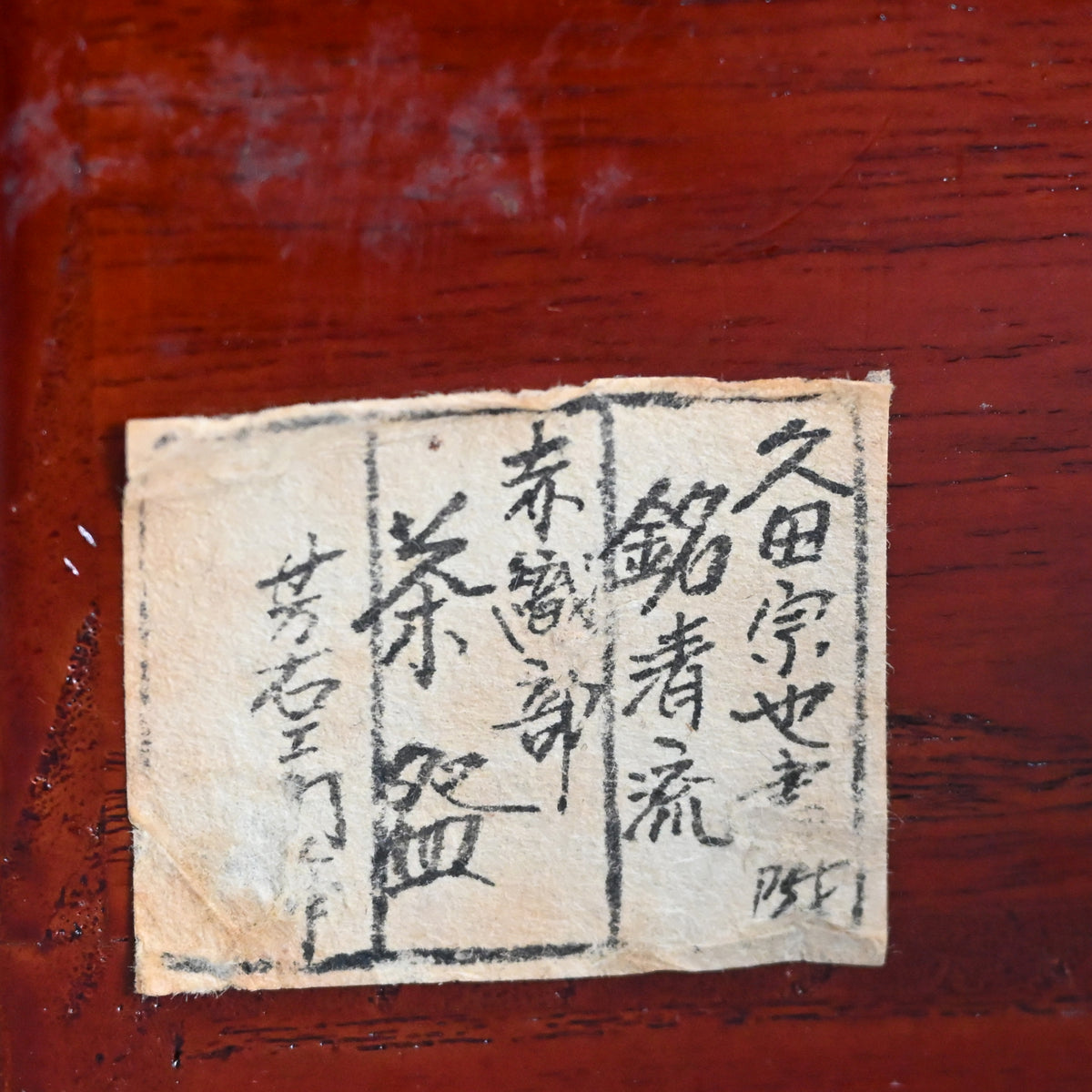
An elegant Aka-Oribe tea bowl by Katō Hōuemon, accompanied by a wooden box inscribed and named Seiryū (Clear Stream) by Hisada Sōya Jingyūsai, twelfth-generation head of the Hisada family and an important tea master of the Omotesenke tradition. The bowl comes in a silk pouch and the signed box is in turn enclosed in a protective red lacquered wooden outer box (nijubako). Broad and shallow in form, the bowl is covered in a warm salmon-red glaze characteristic of Aka-Oribe, across which Hōuemon has drawn a wonderfully spare design of flowing water grasses in fine iron-brown lines, their leaves picked out in creamy white glaze. Small touches of deep Oribe green continue over the exterior, giving the decoration an unexpected rhythm as the bowl is turned in the hand. The composition is particularly well suited to Jingyūsai’s poetic name: rather than depicting a stream literally, the long sweeping stems seem to bend and drift in moving water, suggesting the quiet current of a clear stream. The bowl is accompanied by its silk shifuku, inscribed wooden box, and outer lacquered storage box. It measures 16 cm (6-1/4 inches) in diameter and 5 cm (2 inches) tall and is in excellent condition.
The inscription on the accompanying wooden box is by Hisada Sōya Jingyūsai, twelfth-generation head of the Hisada family, an important lineage closely associated with the Omotesenke school of tea.
Katō Hōuemon (1932-2009) was born in Gifu Prefecture, the eldest son of the celebrated Mino potter Katō Jūemon, an Intangible Cultural Property of Gifu Prefecture, and elder brother of potters Katō Kōuemon and Yaemon. In 1958 he established the Yasaka Kiln at Kukuri together with his father, initially producing works under the name Jūhō before assuming the name Hōuemon in 1974. Inheriting his father’s exceptional command of the ceramic traditions of the Momoyama period, Katō became particularly admired for works inspired by classical Mino wares, interpreting their robust forms and richly fired surfaces with a softer elegance suited to the aesthetics of the Senke schools of tea. His distinctive, gently refined approach to Momoyama ceramics earned him a devoted following among tea practitioners.
Hisada Sōya (1925–2010), better known by his tea name Jingyūsai, was the twelfth-generation head of the Hisada family, one of the most important hereditary tea families closely associated with Omotesenke. Born in Kyoto as Hisada Kazuhiko, the eldest son of the eleventh-generation Hisada Sōya, Mutekisai, he studied history at Kyoto University and entered the Omotesenke tradition under Sokuchūsai Sen Sōsa XIII, becoming an important teacher and authority on chanoyu. He later served as a director of Omotesenke Fushin’an and was particularly respected for his extensive knowledge of tea utensils and tea history, publishing books including Cha no Dōgu and Chanoyu Yōgoshū. He was also known as Hanshōan, the name of the celebrated tea room and residence associated with the Hisada family.