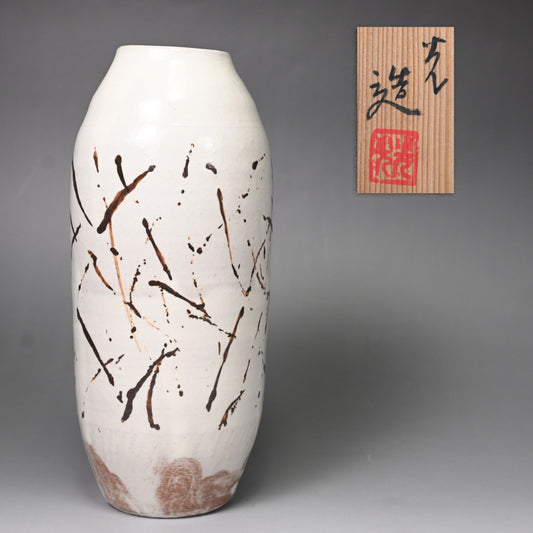
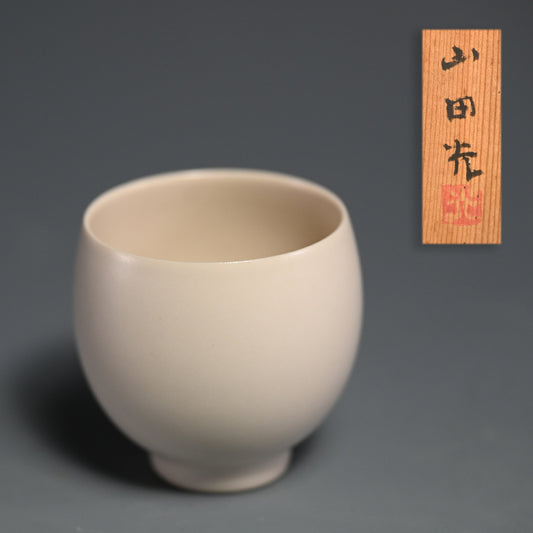
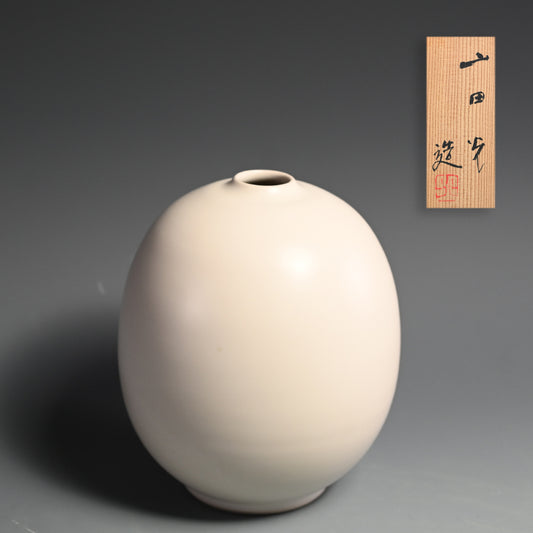
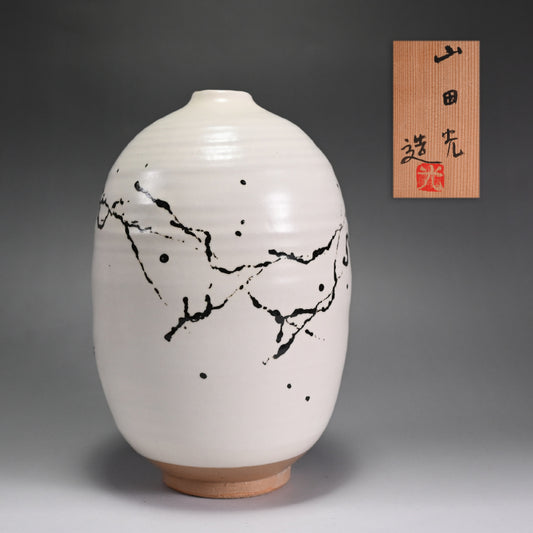
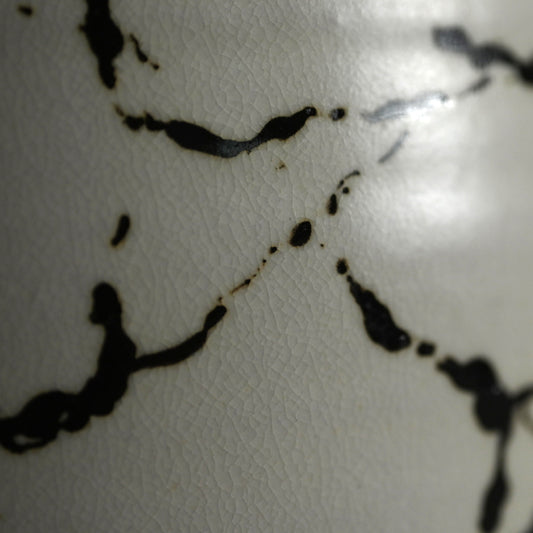
Yamada Hikaru (1924–2001) was born into the family of lay potter and Buddhist priest Yamada Tetsu. After the family home was destroyed in the Great Kantō Earthquake, he was raised in Gifu Prefecture. At the age of twenty, Yamada entered the Kyoto Ceramic Research Institute, where he trained alongside artists who were fifteen years his senior—many of whom had gone on to inspire the Mingei movement.
Avoiding overseas military service during the war, Yamada met Yagi Kazuo in 1945, and the two formed an immediate and lasting bond. The following year they established a group for young ceramic artists, forged under the severe austerity and poverty of the immediate postwar period. This group expanded to include Kumakura Junkichi and Suzuki Osamu, and in 1948 formally became Sōdeisha, one of the most influential ceramic collectives in postwar Japan.
Rejecting public competitions, Sōdeisha championed the idea of art for art’s sake, directly opposing the functionalist ideals of the Mingei movement. Through their collective and individual efforts, its members worked tirelessly to redefine Japanese ceramics as a modern art form, promoting it both domestically and internationally over several decades.
Yamada Hikaru’s works are held in numerous public and private collections, including the National Museum of Modern Art (Tokyo and Kyoto), the Art Gallery of New South Wales, and the Victoria and Albert Museum.