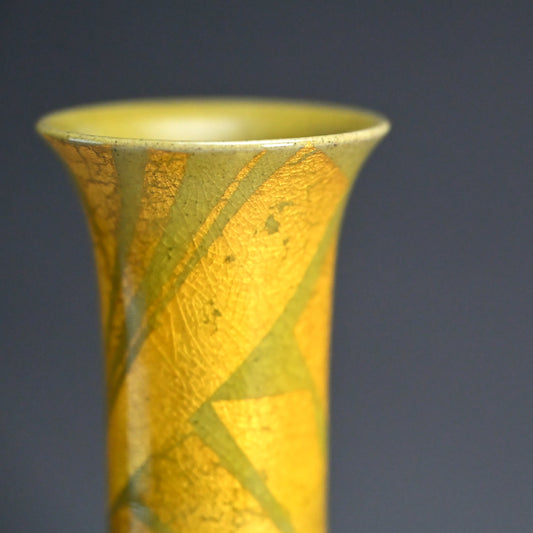
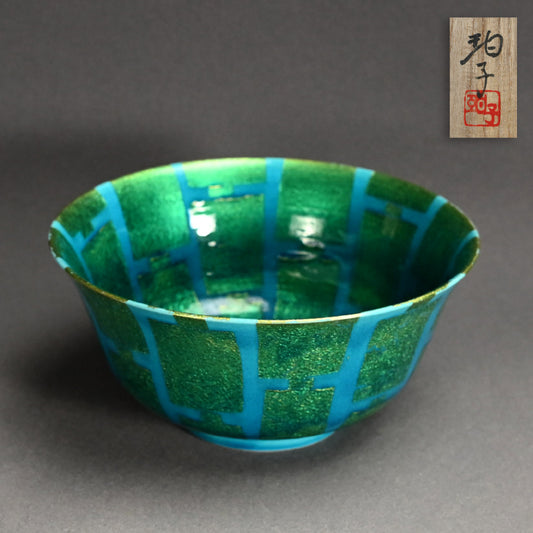
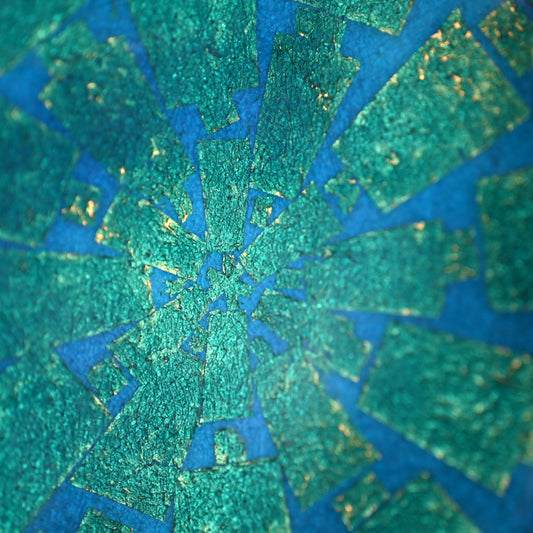
Ono Hakuko (1915–1996) was born in Aichi Prefecture and trained in ceramics by her father, Ono Kozan, within the family workshop. Early in her career she was profoundly influenced by the work of Kato Hajime, whose yūri‑kinsai (underglaze gold leaf) techniques shaped her own artistic direction. After years of dedicated experimentation, she perfected this highly demanding decorative process and developed a distinctive style that combined refined form with delicate, luminous gold surfaces.
Her work garnered major recognition throughout her career. In 1981 she became only the second woman to receive the Japan Ceramics Society Prize, an honor reflecting both technical mastery and artistic innovation. In 1992 she was designated an Important Intangible Cultural Asset of Saga Prefecture for her mastery of the yūri‑kinsai technique.
Ono’s ceramics were exhibited widely in Japan and abroad and are held in prominent collections, including the National Museum of Modern Art, Tokyo; the Minneapolis Institute of Art; the Smith College Museum of Art; the Musée National des Arts Asiatiques in Paris; and the Art Gallery of New South Wales in Sydney. Her success in a historically male‑dominated field and her elevation of a rare decorative technique have secured her a lasting place among the most significant figures in 20th‑century Japanese ceramics.
An EXHIBITION that also displayed her works "Kaika" Digital Catalog