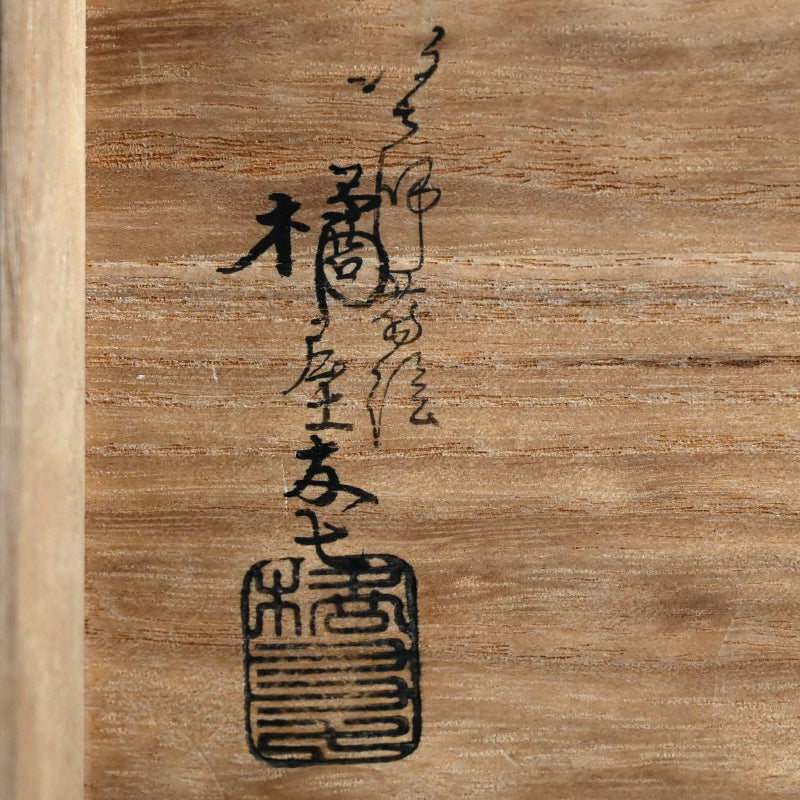
A spectacular boxed set of five lidded lacquer bowls decorated with fine patterns in gold from Tachibanaya Asano Tomoshichi dating from the later Edo period enclosed in the original signed wooden box with a specialized compartment cut in for each bowl. The interiors are festive red with swirling lattice work patterns alternating with auspicious dials, while outside lattice-work and fish-scale patterns are pierced by windows featuring scenes of travel over a belt of Kanji characters. Perfect for a Kaiseki meal, each bowl and lid come enclosed in a cloth pouch upon which is written Tachibanaya Nimono-Wan. The five bowls are 14 cm (5-1/2 inches) diameter, 10 cm (4 inches) tall and in excellent condition.
Tachibanaya Tomoshichi was the successor to the celebrated Kyoto lacquer master Nagano Yokobue, who had founded the lacquerware shop “Tachibanaya.” Under the second generation the enterprise flourished, but with the early passing of the third generation, the shop name was inherited by Yokobue’s disciple, Asano Tomoshichi. Although his exact birth and death dates remain uncertain—some sources suggest he died in 1860, while records from the Kyoto Expositions of 1872 and 1878 list entries under “Asano Tomoshichi Exhibition Company,” with other references to the names Asano Sōshichi and Asano Magoshichi—evidence indicates that the first Tomoshichi of Tachibanaya, a pupil of Yokobue, likely died around the end of the Edo period, and that his descendants or kin continued the enterprise. The lacquerware associated with Tachibanaya, such as the elegant tiered picnic boxes adorned with pine, bamboo, and plum in the collection of the Miho Museum, reflects the refined style inherited from Nagano Yokobue, with firm wax-colored lacquer and finely balanced maki-e decoration equally suited to display or practical use.