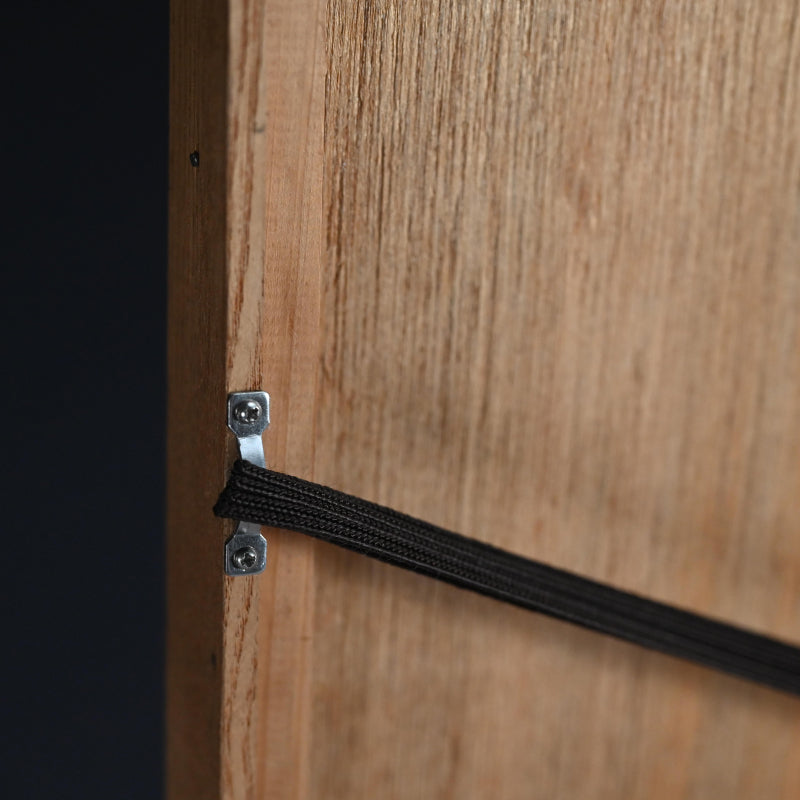
This large early collage belongs to Nomura Kō’s pioneering experiments with discarded newspaper printing flongs—papier-mâché matrices used in rotary press production to create metal printing plates. Removed from the industrial cycle of rapid reproduction, these fragile molds become the structural substance of the work itself. Their raised typographic surfaces, fragments of headlines, tables, advertisements, and diagrams preserving the physical memory of mass communication. Across the surface Nomura arranges the torn fragments in horizontal bands whose jagged edges form a continuous rhythm of serrated peaks. The repeated zig-zag contour evokes a mountainous landscape, transforming the remnants of printed information into a topography of forgotten days. Beneath these layered silhouettes, the relief textures of Japanese characters, numerical grids, and graphic blocks emerge intermittently, like archaeological strata exposed through erosion. The palette remains deliberately restrained—subtle tones of aged paper, pale paste, and darkened ink residue—allowing the physical qualities of the material to dominate. The torn edges reveal the fibrous structure of the flongs themselves, while traces of adhesive and press marks record the process of assembly. Created in 1958, the work reflects the broader experimental climate of the Japanese avant-garde in the postwar period, when artists sought new materials and processes capable of breaking from conventional painting. Nomura’s use of printing debris parallels the era’s interest in automatism, chance, and material immediacy. Rather than representing the modern city, he incorporates its discarded communicative structures directly into the artwork. In doing so, Nomura transforms the ephemeral matter of daily news—information intended to circulate briefly and then vanish—into a quiet and enduring record of the systems that produced it. The result is both materially austere and conceptually rich: a landscape composed not of earth and stone, but of language, information, and the fragile surfaces through which modern society speaks. The work is framed and inscribed on the reverse with the date September 1958 and the artist’s name. Mounted on a wood panel with a simple wood frame, it is 56.7 x 77.5 x 3.3 (22-1/2 x 31-1/2 x 1-1/2 inches) and is in overall excellent condition. It was exhibited at Kyoto’s galerie 16 in a retrospective held in 1981.
Nomura Ko (1927–1991) was born in Kyoto and graduated from the Nihonga Department of Kyoto Municipal College of Art in 1948. In 1950 he joined the Pan Real Art Association (until 1965), establishing himself as a significant figure in the postwar avant-garde movement in Japanese-style painting. Initially influenced by Surrealism, he shifted in the later 1950s toward abstraction and collage, employing unconventional materials such as newspaper printing molds, industrial waste, slate, and cement. From the mid 60”s he was driven beyond the framework to be a pioneer in installation exhibition, creating one-time works which allowed the room to be the frame. Through materially driven works and these later three-dimensional and spatial constructions, Nomura fundamentally redefined the physical and conceptual boundaries of Nihonga. His major exhibition history includes the aforementioned Pan Real (1950-1965), the Asahi New Artist Exhibition, the Asahi Selected Exhibition and the Contemporary Japanese Art Exhibition. Trends in Contemporary Painting (1963), and Today’s Artists ’64 (1964). From 1978 onward, he participated almost annually in the Ge Exhibition. In 1986, he was featured in A Section of Postwar Nihonga at Yamaguchi Prefectural Art Museum. A major retrospective, Kyoto Art: Yesterday, Today, Tomorrow III – Nomura Ko, was held at Kyoto City Museum of Art in 1989. His work was posthumously included in The Turning Point of Postwar Nihonga at Tochigi Prefectural Museum of Fine Arts in 1993, confirming his pivotal role in transforming postwar Nihonga. Work by him is held in the collections of The Kyoto National Museum of Modern Art, Fukui Fine Arts Museum, Kariya City Art Museum, Kyoto City Kyocera Museum of Art, Meguro Museum of Art in Tokyo, Nara Prefectural Museum of Art, Osaka Nakanoshima Museum of Art, Osaka Prefectural 20th Century Art Collection, Tochigi Prefectural Museum of Art, Toyohashi City Museum of Art, Wakayama Museum of Modern Art, Yamaguchi Prefectural Art Museum, Sakuragaoka Museum, The, Kyoto University Art Museum and Kyoto City University of Arts among others.