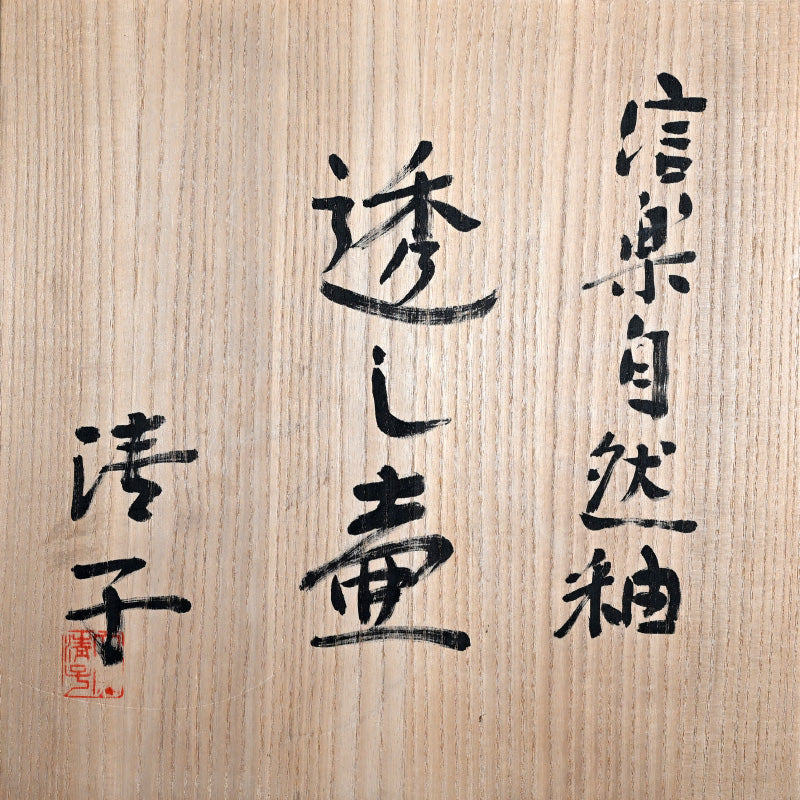
A large and unusual large vessel pierced like a woven basket by legendary female artist Koyama Kiyoko enclosed in the original signed wooden box titled Shigaraki Shizen-yu Sukashi Tsubo. It is 30 cm (12 inches) diameter, 33.5 cm (13-1/2 inches) tall and in perfect condition.
Koyama Kiyoko (1936-2024) was born in Sasebo on the Southern Island of Kyushu. Following the second world war the family moved to Shiga prefecture, eventually settling in the pottery village of Shigaraki. She took a job as a ceramic painter's assistant at a young age. In 1954 she began to work as a pottery decorator in Shigaraki under Nakashima Takamitsu. Later she moved to Kyoto to study Kenzan ware and Sometsuke under Yoshitake Eijiro. Aged 27 she began working in earnest in clay and studying clay technique under Misawa Kenzo. Enthralled by an ancient pot shard with natural blue ash glaze, she sought to recreate this effect in modern times, building her own kiln and repeatedly firing, searching for that magic point, but slowly pushing the family toward insolvency. Not only was she attempting to break barriers with the pots she created, but she was forced to break barriers in a male dominated world where women were prohibited from the wood fired kiln as unworthy. She did have her supporters of course, and with their help and persistence and ever longer firings she eventually succeeded in finding that blue. Kiyoko has a list of shows and prizes which would fill pages, including the Nihon Dento Kogei Ten Traditional Crafts Exhibition, Nihon Togei Ten Ceramic Exhibition, the Asahi Togei Ten Ceramics Exhibition as well as many international exhibitions. Her son Koyama Kenichi (1961-1992) worked to take over the family kiln, but succumbed to Leukemia after a long fight. Their story is the subject of the film Hi-Bi (2005) and the recent NHK television drama Scarlet. She is the preeminent pioneering female wood firing artist in Japan, and bore the brunt of centuries of discrimination against women. Through it all she persevered to become one of the most highly sought of Shigaraki potters. For more on her works see Modern Japanese Ceramics in American Collections, Japan Society New York, 1993. Unfortunately, she passed away just two weeks before this show began.