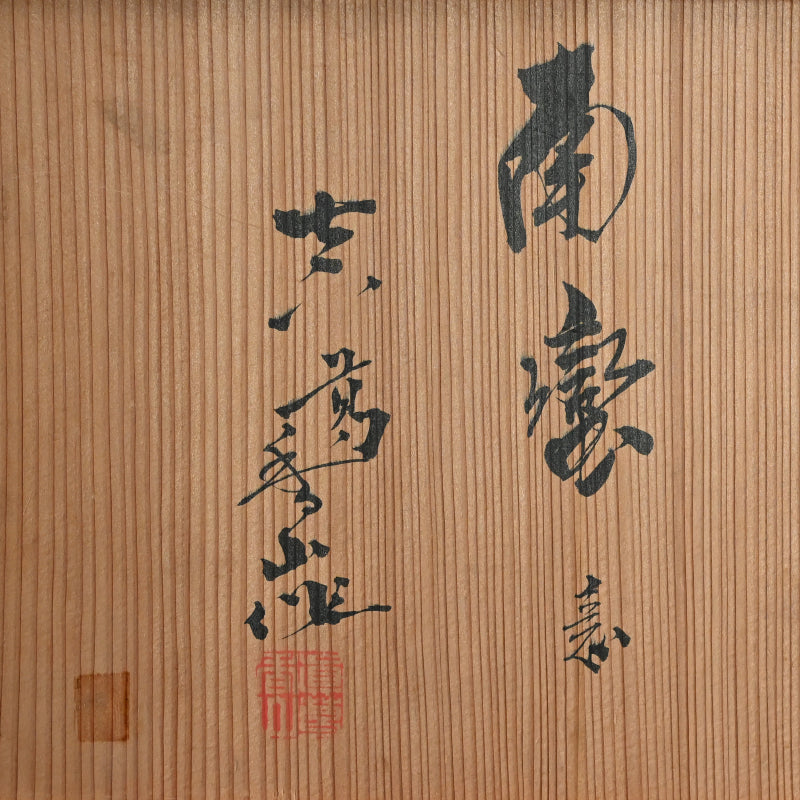
A rare raw earth vessel by the first generation Miyagawa (Makuzu) Kozan enclosed in the original signed wooden box titled Nanban-i Kabin. It is 24 cm (9-1/2 inches) diameter, 22 cm (8-3/4 inches) tall and in perfect condition. Although the outside is raw clay, the inside has been glazed to hold water.
The term Nanban was the Japanese name for the Portuguese, Spanish, and other Europeans who arrived in Japan via Southeast Asian trade routes during the Momoyama and early Edo periods. By extension, "Nanban pottery" came to describe ceramics imported from Southeast Asia and, in some cases, Japanese wares made in imitation of them. Large storage jars, containers, and utilitarian vessels entered Japan through maritime trade networks that connected Southeast Asia, China, and Japan. The Japanese tea world developed a strong appreciation for the rough, unpretentious character of these imported wares. Unlike refined Chinese porcelains, Nanban vessels often displayed asymmetrical forms and coarse clay bodies with natural ash deposits and distorted rims. These qualities resonated with the emerging aesthetic of wabi-cha, which valued simplicity, irregularity, and naturalness. Typical Nanban ceramics feature strong, sculptural silhouettes which appear surprisingly modern because of their directness and lack of ornament. During the Edo period, Japanese potters began producing wares inspired by imported Nanban ceramics. These are sometimes also called Nanban-yaki. Unlike imported Southeast Asian pieces, Japanese Nanban wares were often deliberately made to satisfy tea practitioners seeking the rustic qualities associated with foreign trade ceramics.
The name Kozan was granted by Prince Yasui-no-Miya in 1851 in honor of the tea ware produced during the later Edo for the imperial Court by the tenth-generation head of the Kyoto pottery family Miyagawa Chozo. The Kozan (Makuzu) kiln as we know it today was established in Yokohama in 1871 by the 11th generation head of the family where he reinvented the family business. He immediately set out on a journey which would propel the Kozan name to International Celebrity status, and send his wares throughout the globe. Pieces produced there were marked Kozan, or Makuzu, the official kiln name, or both. Although he had been running the daily operation since the late 19th century, the first son, Hanzan, succeeded as head of the kiln, in 1912, with the father officially retiring to spend more time on his own research and art. Kozan I dies in 1916. The kiln was run by Hanzan (1859-1940) through the early Showa era, he officially taking the name Kozan II in 1917, after one-year mourning for his father’s passing. Under Hanzan the kiln was commissioned for works to be presented to the Prince of Wales, the 25th wedding anniversary gift for the Taisho emperor and the Showa Emperors coronation gift. The unlucky third generation inherited the kiln at the height of the war years, it was completely destroyed in the bombing of Yokohama in 1945. For more on this illustrious family see Bridging East and West, Japanese Ceramics from the Kozan Studio by Kathleen Emerson-Dell.