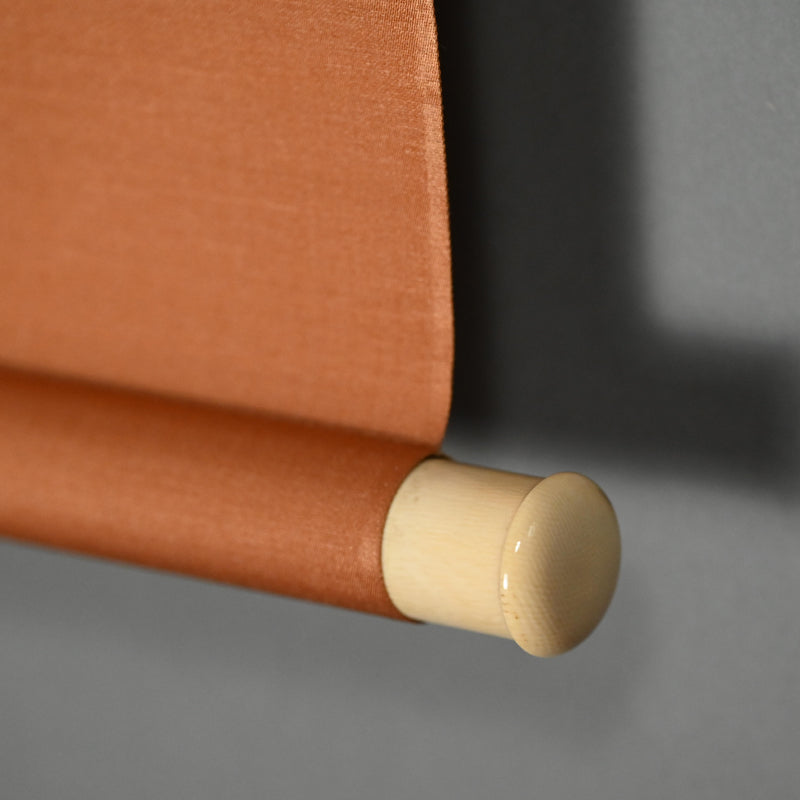
A calligraphic verse by Fukuda Kodojin written in his flowing hand dated the Plum Flower Time of the 14th year of Taisho (early Spring, 1925). Ink on paper in a fine silk border with solid ivory rollers (these will be changed for export) enclosed in a period wooden box. It is 46.5 x 196 cm (18-1/2 x 77 inches) and is in fine condition with minor marks typical of age.
Composing verses at Hanshan Temple:
No monk is even boiling tea.
Light whispers praises like wind through the pines,
And the moon reflected in water, shining utterly clear.
The reference to Hanshan Temple invokes both the real temple near Suzhou and the symbolic world of Kanzan and Jitoku (Hanshan and Shide), the eccentric Tang hermits. By referencing it, Kodōjin places himself in a lineage of solitary poet-sages. The second line conveys solitude—even the temple monk is absent, and there is no tea being boiled. Light, Pine and Wind “praises” or “chants”—this is classic literati language where nature performs the role of companion or spiritual teacher. Whereas the final line Moon in the water” is a Zen-Daoist metaphor for clarity without grasping. The poem ultimately expresses solitary serenity in a mountain temple, where even without human companionship, pine wind and moonlight become ones fellows.
Fukuda Kodojin (1865-1944) was an eccentric self-taught artist, his status as a poet, calligrapher and literati artist has reached legendary status. Born at a time of great change (4 years before the final fall of the Edo Government), he lived through the westernization of Meiji, Taisho Democracy, the rise of Imperialism and final defeat of the Showa eras. He was part of a small group of artists existing outside conventional circles in pre-war Japan. He moved to a village outside of Kyoto in 1901, where he supported himself and his family by privately tutoring those who wished to learn Chinese-style poetry. Kodojin was simply a scholar. His poetry, painting, and calligraphy all stem from a life-long cultivation of the mind. He was said to have taken the time just before his death to destroy the large portion of his own remaining work, leaving only that which must have met some personal criteria. Kodōjin’s paintings and calligraphy survive mainly in private collections, but significant works can be found in the collections of the British Museum, Freer Sackler Gallery of the Smithsonian Institute, Honolulu Museum of Art, Houston Museum of Fine Arts, Kumamoto Prefectural Museum of Art, Minneapolis Institute of Art, Museo Kaluz, New York Metropolitan Museum of Art, Portland Art Museum, Seattle Art Museum, St. Louis Art Museum, Tanabe City Museum of Art and Wakayama Prefectural Museum of Art among others including such well known Private collections as the Cowles Collection, Hakutakuan Collection, Manyoan Collection and Welch Collection. Twenty five paintings by the artist formed a private exhibition (from the Gitter-Yelen collection) at the New Orleans Museum of Art in 2000. In recent years, exhibitions such as The Last Master of the Literati Tradition: Fukuda Kodōjin (Minneapolis Institute of Art, 2023) have brought renewed attention to his achievement. For more on his life see the book Old Taoist, or Unexplored Avenues of Japanese Painting.