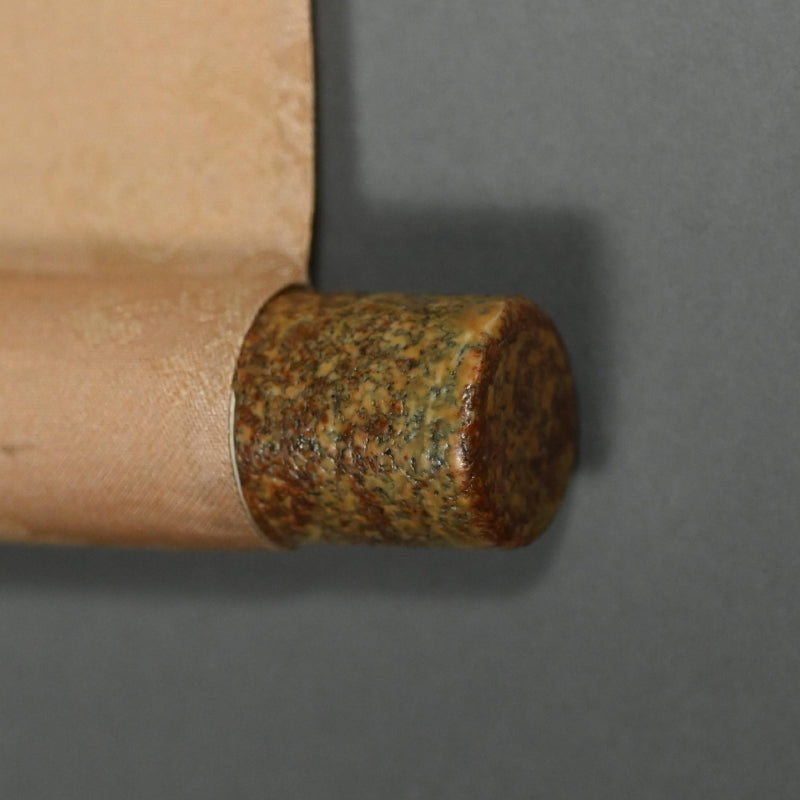
In this boldly reductive ink landscape, Fuji Tatsukichi evokes a rugged mountainside rising sharply from a mist-filled valley, its contours rendered through a deliberately raw vocabulary of dry-brush strokes, dragged ink, and gestural sweeps. The summit dissolves into vaporous clouds, suggested by feathered marks and blurred washes that temper the otherwise assertive, almost tactile presence of the mountain below. Rather than employing traditional compositional detailing, Fuji strips the scene to an elemental interplay of ink, paper, and motion: the mountain appears carved out by forceful vertical passes, while darker passages punctuate the form like abrupt fissures in rock. The work reflects Fuji’s lifelong commitment to experimentation across media—ceramics, lacquer, design, and painting—and his pioneering role in the sōsaku (creative) crafts movement. His painterly landscapes, though fewer in number, share the same modernist sensibility: a move away from descriptive naturalism toward expressive immediacy. Here, the mountain becomes less a literal topography and more an impression of nature’s mass and atmosphere distilled into a handful of brushstrokes. The minimal notation of a distant ridge and drifting cloudline enhances the sense of depth without compromising the painting’s stark, contemporary silhouette. This landscape exemplifies Fuji’s ability to translate traditional East Asian ink practice into a distinctly modern idiom—one that favors spontaneity, materiality, and emotional charge over academic finish. It is 37.5 x 158 cm (15 x 62 inches). There are minor marks typical of age.
Fujii Tatsukichi (1881-1964) could be considered the father of the Arts and Crafts Movement and the modern concept of design as an art form in Japan, and most certainly an artist not to be defined by one medium. He was born in Hekinan city, Aichi prefecture near Nagoya. He was, along with Kishida Ryusei, Saito Yori and Takamura Kotaro, a founding member of Hyuzan-kai in 1912, the first organization in Japan dedicated to Expressionism in all forms through all mediums. He was one of the most important reformers of the traditional arts in Japan and a pioneer of the modern craft world. His creativity touched nearly every area: embroidery, dyeing, weaving, lacquer, pottery, papermaking, metalwork, woodwork, Painting, calligraphy, woodblock carving and printing. In the 1920s he wrote articles on home crafts for Fujin no Tomo, one of the most widely read women’s magazines of the day. He also held the first professorship of design at the Imperial Art School (mod. Musashino Art University), and his influence was enormous. The museum of contemporary art in Tatsukichi’s birth place, Hekinan, is named after him. In 1932 he established a studio in Obara, where he headed the movement to reinvent the Japanese craft paper industry. That studio (Mufuan) has been moved and is now used as a tea house by Seto City. A major retrospective on his life work travelled japan in 1996 spearheaded by the Tokyo National Museum, “Fuji Tatsukichi, Pioneer of Modern Crafts”.