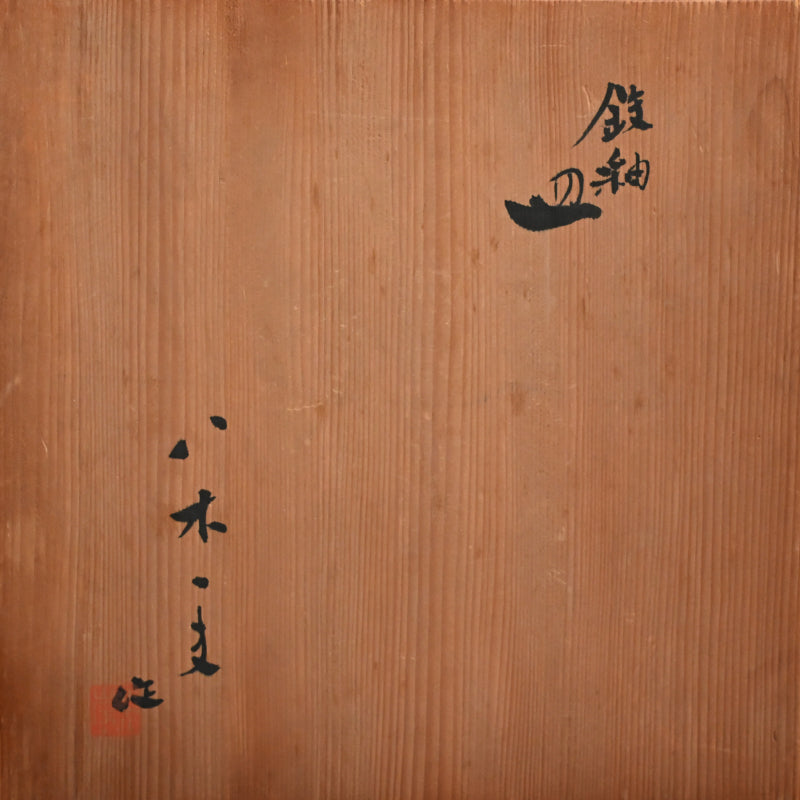
A crescent moon in studded red clay is eclipsed in shadowy dark glaze truly accentuating the idea of “Tsuchi-no-aji” (the flavor of clay) by important Sodeisha artist Yagi Kazuo enclosed in the original signed wooden box titled Tetsu-yu Sara. It is 25.5 x 26 x 4.5 cm (roughly 10 inches diameter, 2 inches tall) and is in excellent condition.
Yagi Kazuo (1918-1979) was one of the most influential Avant Garde potters of 20th century Japan. He was born into the family of potter Yagi Isso, a noted specialist in fine Chinese and traditional Japanese forms and glazes. Kazuo studied at the Kyoto Ceramics Research Facility, like many great potters before him including his father and the founders of the Mingei movement, Kawai Kanjiro and Hamada Shoji. While there immersed in traditional forms, he joined the Ceramic Sculpture Association of Japan, and in 1939 was exhibited with them. Drafted shortly thereafter, he was sent to China, but quickly returned to Japan with illness, for which he was discharged, and went back to sculpture, very much influenced by Western Art movements of the time. The war years were difficult of course, but following Japan’s Surrender, Kazuo was accepted into the Nitten National Exhibition. Like many young artists who had been held in the yolk of Japan’s strict military regime, he was grasping for something new, and his work expressed a strong desire to throw off the weight of traditionalism and function. So it was in 1948 when Kazuo, along with a number of other potters including Suzuki Osamu, Yamada Hikaru and Kumakura Junkichi, founded the Iconic Sodeisha Group. The work of this group would change forever the perception of Japanese pottery, and he would go down as one of the most influential potters of the 20th century.