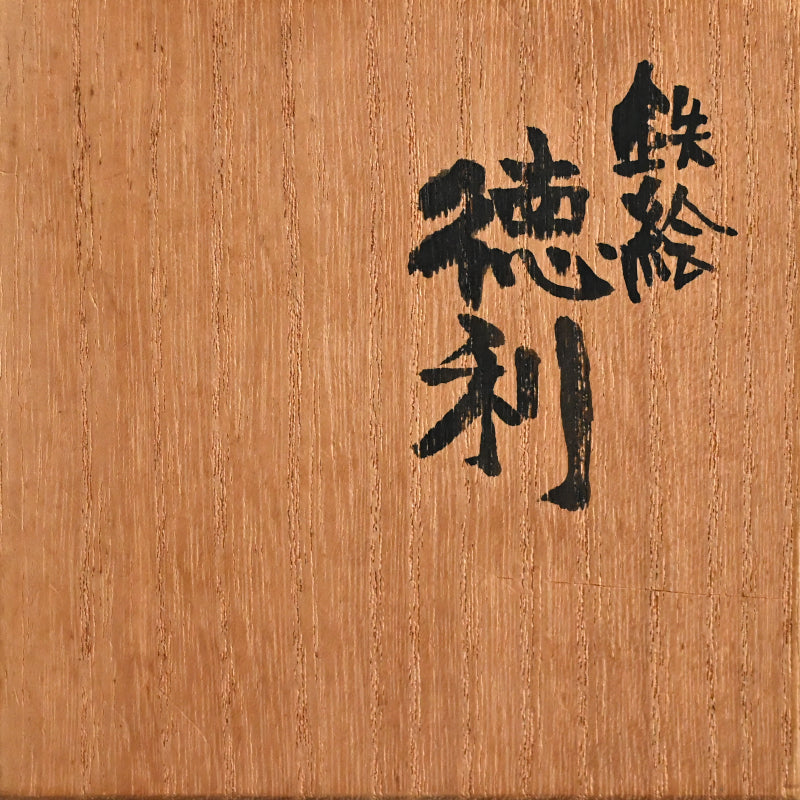
A wonderfully expressive iron-painted sake flask by Living National Treasure Shimizu Uichi, enclosed in the original signed wooden box titled Tetsu-e Tokkuri. The compact, slightly irregular body rises to rounded shoulders and a short neck terminating in a thick, softly distorted mouth, the entire form retaining the immediacy of its making. A translucent grey-green ash glaze covers the vessel, pooling and thinning over the uneven surface and breaking to warm ochre along ridges and edges. Beneath and within the glaze, freely brushed iron decoration appears as wandering brown lines, dashes and angular strokes, some sharp and calligraphic, others dissolving into the glaze during firing. Horizontal lines encircling the shoulder play against these spontaneous marks, giving the small vessel a remarkable sense of movement. Fine crazing, pinholes and areas where the glaze has crawled or contracted further enliven the surface, while the underside is particularly rugged, revealing the effects of firing in a dense landscape of exposed clay, fused glaze and kiln markings. Rather than disguising these irregularities, Shimizu makes them integral to the character of the work, balancing deliberate brushwork against the unpredictable transformations of fire. It measures 9 cm (3-1/2 inches) in diameter, 14 cm (5-1/2 inches) tall and is in perfect condition.
Shimizu Uichi (1926-2004) was born in Kyoto the son of a ceramic dealer. Discarding the family business, he apprenticed in plastic arts under future Living National Treasure Ishiguro Munemaro. His work retains some principal elements of his teachers style while incorporating an understated elegance and avant-garde spirit of challenge uncommon for his time. He was first exhibited at the Nitten in 1951, receiving numerous awards there since. He also took the gold medal at the Prague International Exhibition, and was at the Brussels World Exposition. He is in the collection of the Tokyo National Museum, Kyoto Museum of Modern art, Clark Center and the Freer Gallery among many others.