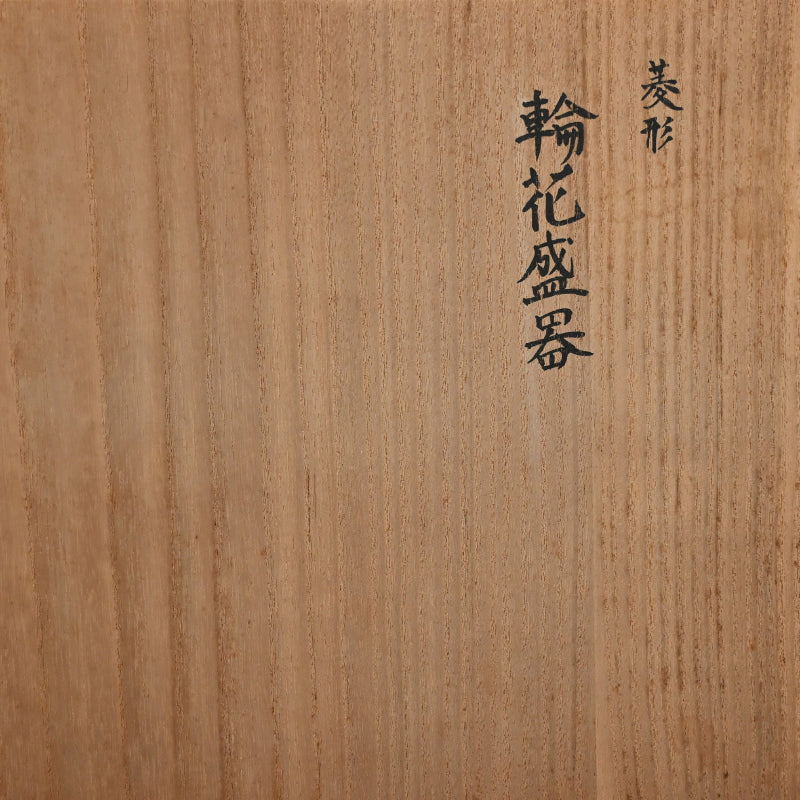
A beautifully carved moriki serving vessel by Living National Treasure Nakadai Zuishin, enclosed in the original signed wooden box titled Hishi-gata Rinka Moriki (Diamond-Shaped Foliated Serving Vessel). Carved from a solid block of wood, the broad square form is transformed by a deeply undulating rinka rim, its overlapping lobes opening outward like the petals of a chrysanthemum. The interior rises rhythmically from the square central well through each individually carved petal, while the exterior retains a remarkably clean, shallow profile supported upon four discreet feet. Particularly beautiful is Nakadai's treatment of the grain: rather than merely allowing the natural pattern of the wood to decorate the surface, he uses the direction and concentric movement of the grain to reinforce each carved lobe, giving the vessel a sense of growth from its center outward. A warm translucent finish deepens the reddish-golden tones while leaving the grain and subtle marks of the carving clearly visible. An unlacquered example of the same form and title is held in the collection of Japan's Agency for Cultural Affairs. It measures 33.5 x 29.5 x 6.5 cm (13-1/4 x 11-5/8 x 2-1/2 inches) and is in excellent condition.
Nakadai Zuishin (1912–2002) was a premier Japanese woodworker who was designated a Living National Treasure (Preserver of Important Intangible Cultural Property) in 1984. He was highly celebrated for his mastery of the kurimono technique, a traditional craft of carving and hollowing out solid blocks of wood—such as paulownia or mulberry—using chisels and planes. His work is characterized by its sharp, elegant contours and a profound respect for the natural beauty of the wood grain, which is epitomized in masterpiece creations like his diamond-shaped foliated bowls. Born on August 8, 1912, in Kemigawa, Chiba City, Chiba Prefecture. His grandfather was a carpenter, which sparked his early passion for working with wood. In 1926, at the age of 14, he moved to Tokyo to apprentice under Fuzan Takeuchi, a renowned master of sashimono (traditional Japanese joinery/furniture making). Under Takeuchi, he learned to handle various woods—such as mulberry, cedar, cypress, and paulownia—gaining deep expertise in making intricate wooden boxes and tea ceremony utensils. In 1933, at age 21, he established his own independent workshop in Tokyo (in the Nishikubo Tomoecho district, current-day Toranomon, Minato Ward). To elevate the quality and spirit of his work, he studied the Japanese tea ceremony directly under Tanaka Sensho, the founder of the Nihon Sado Gakkai (Japan Tea Ceremony Society). This close relationship allowed Nakadai to intimately understand the aesthetics required for high-end tea utensils, shelves (tanamono), and boxes. During the Second World War he was tasked with producing wooden components for fighter planes. After the rebuilding of Japan, by around 1960, Nakadai began feeling creative limitations with the linear constraints of joinery (sashimono). He pivoted his main focus toward kurimono—the arduous, traditional craft of carving and hollow-gouging solid blocks of raw wood. He specialized in paulownia (kiri) wood, a material notoriously soft and difficult to carve cleanly without leaving crushing marks. In 1962, he made his competitive debut at the 9th Japan Traditional Crafts Exhibition. The very next year, in 1963, he won the prestigious Encouragement Award, launching him into the upper echelons of the Japanese craft community. He subsequently served as a judge and board member for the Nihon Kogeikai Crafts Association, and became the head of its Wood and Bamboo Division in 1980. In 1984, Nakadai received the highest honor for a Japanese craftsman: he was designated a Living National Treasure (Important Intangible Cultural Property holder) for his mastery of Woodcraft (Mokugei). He was only the third person in Japanese history to achieve this designation for woodworking. He was awarded the Order of the Sacred Treasure (4th Class) in 1983. Nakadai continued crafting beautiful, minimalist trays, bowls, and tea utensils that highlighted natural wood grain until late in his life. He passed away from old age at his home in Minato Ward on April 23, 2002, at the age of 89.