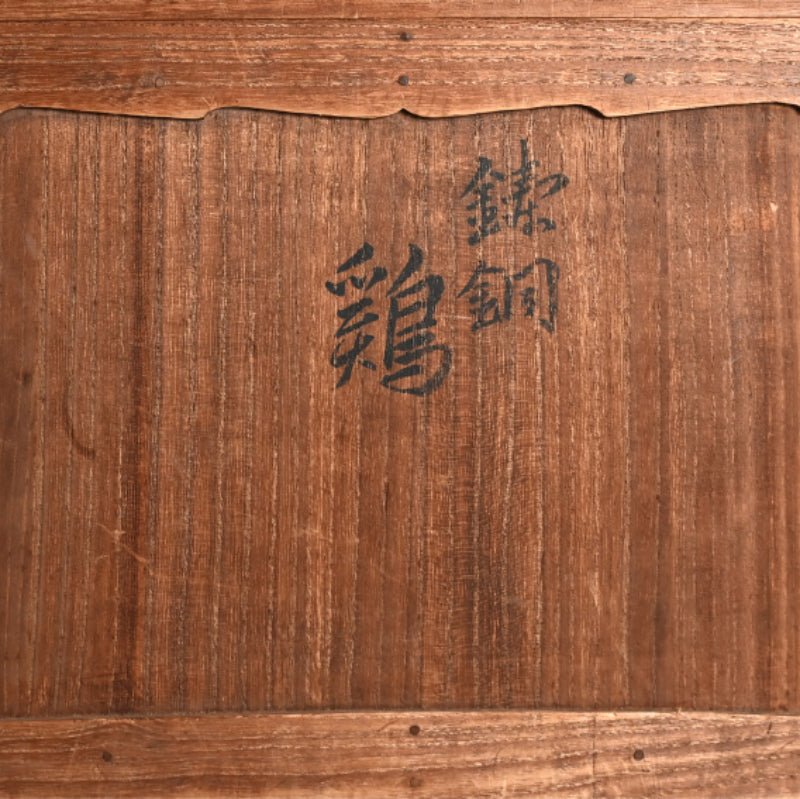
A wonderfully animated group of bronze chickens by Living National Treasure Katori Masahiko, enclosed in the original signed wooden box titled Chūdō Niwatori (Cast-Bronze Chickens). A large hen stands protectively over her brood of four chicks, each modeled separately and arranged freely around her feet. Katori reduces the birds to broad, beautifully controlled volumes, the swelling breast and sweeping wings of the hen contrasting with the lively poses, delicate legs and individually modeled expressions of the chicks. Details of eyes, comb, feathers and feet are crisply articulated without disturbing the smooth sculptural surfaces, while a deep brown-black patination unifies the group. Particularly engaging is the relationship between the monumental, watchful mother and the chicks moving independently beneath and around her, giving the ensemble both tenderness and a quiet sense of humor. The group is accompanied by its original black lacquered wooden display stand. The large hen measures 30 x 22 x 22.5 cm (11-3/4 x 8-5/8 x 8-7/8 inches), and the ensemble is in overall excellent condition.
Katori Masahiko (1899–1988) was born in Tokyo the eldest son of the distinguished metal artist Katori Hozuma. He spent his childhood in present-day Sakura City, Chiba Prefecture. From 1916 to 1920 he studied Western-style painting at the Taiheiyō Gakai Research Institute, before entering the Casting Department of the Tokyo School of Fine Arts (now Tokyo University of the Arts) in 1920, where he studied under Tsuda Nobuo with a strong foundation in classical research. After graduating in 1925, he received a bronze medal at the Paris International Exhibition of Modern Decorative and Industrial Arts for Vase with Strawberry Arabesque Design. Katori made his debut at the 9th Teiten (1928) and went on to receive Special Prizes for three consecutive years (1930–1932), achieving jury-exempt status. After World War II, he devoted himself to the restoration and protection of cultural properties and, from 1950 onward, produced more than 150 Buddhist temple bells. Notable works include the Friendship Bell (San Diego, 1958), bells for Enryaku-ji (1963), Ikegami Honmon-ji (1964), and the Peace Bell at Hiroshima Peace Memorial Park (1967). He received the Japan Art Academy Prize in 1953, was designated a Living National Treasure (Important Intangible Cultural Property holder) in 1977, and became a member of the Japan Art Academy in 1988.