Literati Scroll by Samurai Daimyo ー佐竹 義政
Literati Scroll by Samurai Daimyo ー佐竹 義政
Item Code: L017
Couldn't load pickup availability
The view is that of a hawk circling over a lonely hut lost deep in the steep misty North, home of the powerful gentleman Warrior Satake Yoshimasa (1775-1815) —daimyō of Akita and celebrated bunjin tonosama (“cultured lord”)—by whose hand we meet this scene. Thius reveals the refined artistic sensibility for which he was renowned. Rendered in bold ink washes that cascade across the vertical composition, the scene unfolds from mist-cloaked peaks at the top to a torrent-cut ravine below. Yoshimasa’s brush shifts fluidly between soft, atmospheric veils and sharply accented strokes, creating a world in which mountains breathe with vapor and forests dissolve into banks of cloud. Amid the dramatic rush of water and rock, a lone scholar sits on the veranda of a rustic pavilion, gazing outward in contemplation as branches arch protectively overhead. This small human presence—serene against the forces of nature—encapsulates the literati ideal Yoshimasa deeply admired: the cultivated official who balances duty with quiet retreat, scholarship with sensitivity to landscape. Though painted by a provincial lord far from the cultural capitals, the work demonstrates a sophisticated understanding of Nanga idioms circulating in Edo-period intellectual circles. Yoshimasa’s command of modulated ink, his interest in dynamic weather, and his emotive rendering of distant slopes place him firmly within the aesthetic lineage of eighteenth- and nineteenth-century literati painting. At the same time, the painting carries an unmistakably personal tone: an expression of the artist-governor whose life was marked by both political responsibility and a profound devotion to the arts. Following the signature on this scroll is a large faded stamp reading Yoshimasa Kunsho. The scroll is signed Jofukyusai, one of the many names used by Yoshimasa, Warlord of Akita.
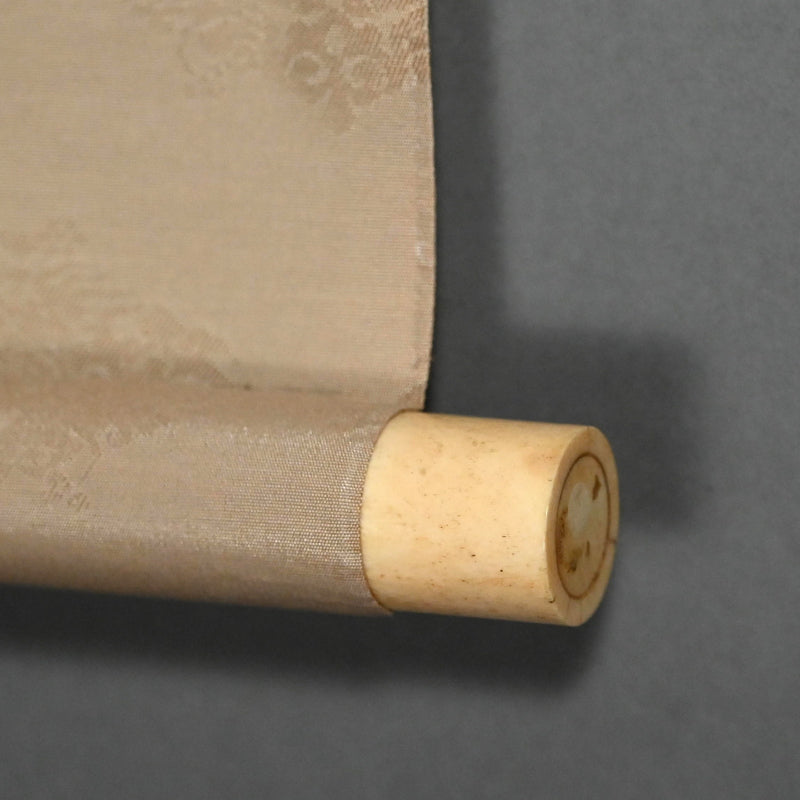
Satake Yoshimasa, (also called Nishinsai, Taiga, Kafutei and Rosui) was adopted by the head of the Satake clan, Yoshiatsu, soon after birth. The father figure died when Yoshimasa was ten, leaving a young boy in charge of the rugged Satake domain which spanned most of Northern Japan. Yoshimasa, known as “The cultured governor” or Bunkajin Tonosama, worked tirelessly to develop not only his skill in the arts, but also his holdings. He is largely responsible for turning around the fortunes of Akita, developing infrastructure and raising production to levels never before seen. A brilliant administrator. He accomplished all of this before his 40th year. A painting by him is on display in the Yuzawa library, as well as Tentokuji Temple. The scroll has been completely remounted in rich, blue brocade boldly patterned with peony, extended in beige and retains the original bone rollers. It is 41 x 193 cm (16 x 76 inches) and in fine condition.
Satake Family Patronage and the Rise of Akita Ranga
The Satake clan—lords of the Akita domain from the early seventeenth century—played a decisive role in the birth and cultivation of Akita Ranga, Japan’s earliest and most intellectually rigorous engagement with Western, particularly Dutch, painting methods. Emerging in the mid-eighteenth century, Akita Ranga was not merely an artistic curiosity; it was a domain-supported cultural project rooted in scientific inquiry, economic development, and aesthetic innovation.
The origins of this movement lie with Satake Yoshiatsu (1748–1785), Yoshimasa’s ancestor and one of the most remarkable polymath daimyō of the Edo period. Under the scholarly name Satake Shōzan he championed Western natural science, optical theory, and copperplate engraving, introducing practices from Rangaku (Dutch Learning) into the domain’s artistic sphere. With the cooperation of retainers deeply interested in natural history—including Hiraga Gennai, who visited Akita in the 1770s—Yoshiatsu cultivated a circle of painters who studied Western books, copper engravings, and scientific diagrams imported through Nagasaki.
The result was a school of painting unprecedented in Japan: works that emphasized empirical observation, botanical accuracy, shading, linear perspective, horizon systems, and three-dimensional modeling. Artists produced images of flora, fauna, and landscapes that departed radically from traditional East Asian brush conventions. Their paintings and prints represented an effort to reconcile Chinese literati aesthetics with Western naturalism—an experiment that would influence Japanese visual culture through the nineteenth century.
The Satake lords provided not only moral and artistic support but also institutional infrastructure: access to imported books and drawings, education in Dutch science, workshops for copperplate engraving, and active promotion of domain artists in Edo intellectual circles. Yoshiatsu himself studied optical devices, camera obscura techniques, Western pigment use, and anatomical treatises, all of which informed the movement’s painterly approach.
By the time of Satake Yoshimasa—the cultured governor known for revitalizing Akita’s political and economic fortunes—this legacy had become central to the domain’s intellectual identity. While Yoshimasa’s own paintings are framed more within the East Asian literati tradition than strict Ranga naturalism, his patronage continued the Satake ethos of scholarly engagement, artistic exploration, and domain-wide cultivation of cultural capital. His leadership stabilized the region after decades of economic strain, enabling cultural pursuits—such as the arts, agricultural reforms, and infrastructure projects—to flourish anew.
In this way, the Satake family left an enduring imprint on Japanese art history: they created one of the earliest sustained environments in which Western visual knowledge could be studied systematically, adapted creatively, and ultimately woven into the fabric of Japanese painting. Akita Ranga stands today as a symbol of daimyō-led innovation, and the Satake clan’s patronage remains a central chapter in the story of Japan’s encounter with European art.
Share