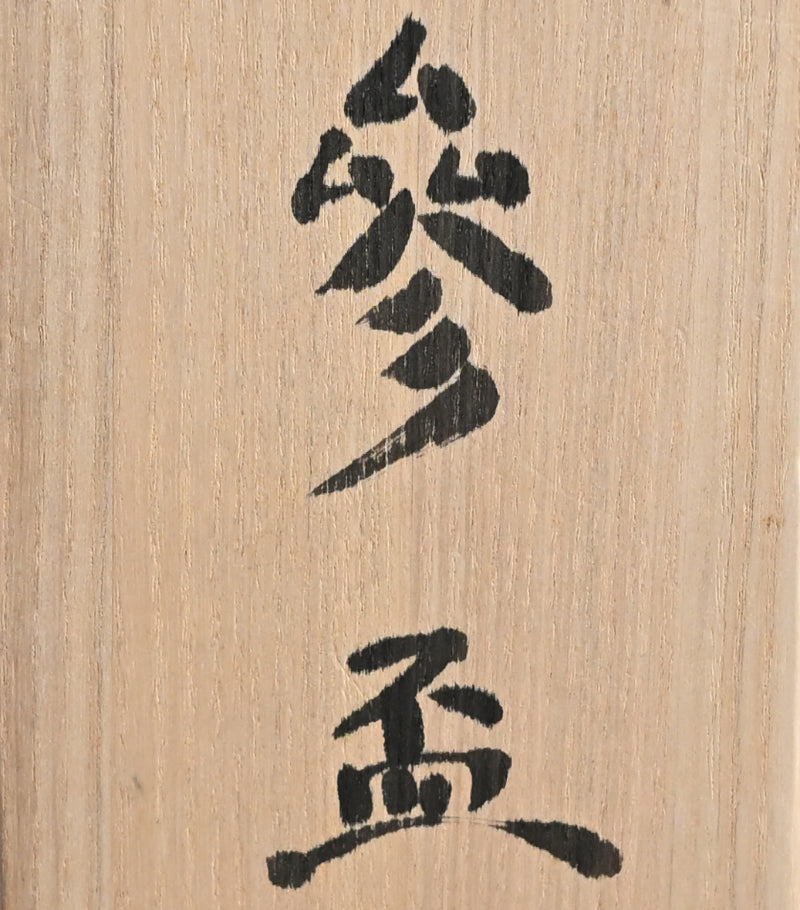
Guinomi Set: Morino, Yanagihara, and Miyanaga ー“参盃”, 森野 泰明 “黒銹” / 柳原 睦夫 “彩釉” / 宮永 理吉 “影青”
Guinomi Set: Morino, Yanagihara, and Miyanaga ー“参盃”, 森野 泰明 “黒銹” / 柳原 睦夫 “彩釉” / 宮永 理吉 “影青”
Item Code: MC1781
Couldn't load pickup availability
An unprecedented boxed set of three unique Guinomi sake cups by progressive Kyoto representatives Morino Taimei, Yanagihara Mutsuo and Miyanaga Rikichi (Tozan III) enclosed in the original signed wooden box titled Sanpai. They measure:
Morino Taimei: Kuro-sabi 7.5 x 4.7 cm (3 inches diameter, 2 inches tall)
Yanagihara Mutsuo: Sai-yu 7.3 x 4.7 cm (3 inches diameter, 2 inches tall)
Miyanaga Rikichi: Keisei 7.3 x 4 cm (3 inches diameter, 1-1/2 inches tall)
Morino Taimei was born in Kyoto in 1934, and was first accepted into the Nitten National Exhibition at a relatively young age in 1957 (a year before graduating the Kyoto Municipal University of Fine Art!). In 1960 he received the prestigious Hokutosho prize at the same National Exhibition. In the early 60s he worked as a guest professor at the University of Chicago. Upon his return to Japan his career began to lift off with a second Hokutosho Prize at the Nitten, followed by The governors prize and others at the Gendai Kogei Ten (Modern National Crafts Exhibition). He was subsequently selected for display at the Kyoto and Tokyo National Museums in 1972 and was accepted into the first Nihon Togei Ten that same year. Since his list of exhibitions and prizes has continued to grow, with subsequent selections in the Tokyo and Kyoto museums of Art, as well as exhibitions in Paris, Italy, America, Canada, Denmark and others. In 2007 he received the Japan Art Academy Prize, an award to a work of art similar in weight to the bestowing of Living National Treasure to an artist. This puts the artist in a small club, rare and important. For more information on the artist see Contemporary Japanese Ceramics, Fired with Passion by (Lurie/Chan, 2006) or the recent exhibition of works titled Generosity in Clay from the Natalie Fitz-gerald Collection.
Yanigahara Mutsuo (b.1934) was raised in Seto, and studied in Kyoto along with contemporary Morino Taimei with whom he maintained a lifelong friendship. His work is largely sculptural, and his choice of colors is his reflection on the decadence of Japanese society. A list of exhibitions and awards would be much too long but includes the Japan Ceramics Society Gold prize in 2002. Listed as one of the most influential potters of the 20th century in the Japanese ceramics magazine Honoho Geijutsu, he is held in the Museum of Modern Art, both Tokyo and Kyoto (MOMAT, MOMAK), The National Museum of Art, Osaka, V&A, Great Victoria Art Gallery, Portland and any number of other prominent public and private collections throughout the world. For more see Japanese Studio Crafts, Tradition and the Avant Garde by Rupert Faulkner. According to the V&A his “work is striking for its blend of dynamism, color and wit. A leading figure among Kyoto artists, Yanagihara has taught at Osaka University of Arts since 1968. Yanagihara's application of brightly colored abstract motifs to vessel forms with anatomical, sometime sexually explicit features - a combination with which he first experimented in the late 1960s and early 1970s - has been a characteristic of his work for the past fifteen years. As in the case of Morino Taimei, a close friend and exact contemporary at Kyoto City University of Arts in the late 1950s, Yanagihara has been considerably influenced by the experiences he gained during two periods of teaching in the United States in 1966-8 and 1972-4. His use of gold and silver - a wry comment, he has explained, on the decaying values of contemporary society and the corruption of Japan's political system - echoes the extravagant style of certain North American artists.”
Miyanaga Rikichi was born the son of Miyanaga Tozan II in Kyoto in 1935. His grandfather, Tozan I, had been one of only five potters ever awarded the title of Teishitsu Gigei-in, member of the Imperial Art Academy. Rikichi graduated the Kyoto Municipal University of Arts Sculpture department in 1958, at the height of the post-war avant-garde movement. In 1960 he dropped out of the masters course there to travel the Americas and study. His work was quickly picked up in Japan, garnering his first major entry with a piece in the “Survey of Contemporary Art” at the National Museum of Modern Art, Kyoto in 1964 (MOMAK). In 1970 he became a member of Sodeisha after leaving the group Kohdo Bijutsu, and was selected as one of six potters for a group exhibition in New York with the Ruth Chandler Williamson Gallery. This same year he was exhibited again at MOMAK with “Contemporary Pottery : Europe and Japan. With this both domestic and international recognition, his reputation was set, and he has gone on to many group and private exhibitions and awards both within and without Japan. He succeeded the family name as the third Tozan in 1999. The next year saw his work at “’Utsuwa’: Thoughts on Contemporary Vessels,” at The National Museum of Modern Art, Tokyo and his record has only grown from there, receiving the order of cultural merit from Kyoto among many other prizes. Work by him is held in The National Museum of Modern Art, Tokyo / The National Museum of Modern Art, Kyoto / The Japan Foundation / The Art Gallery of New South Wales, Australia / The V&A London / Kyoto Municipal Museum of Art / The Museum of Oriental Ceramics, Osaka / Kure Municipal Museum of Art / Musée Ariana, Switzerland / Museus d’Olot, Spain / Les Arts Décoratifs, France / Everson Museum of Art, the United States and many others. According to the V&A: Miyanaga belongs to what is sometime described as the 'second generation' of avant-garde Japanese ceramists. The term is used to refer to artists who established themselves during the late 1960s and 1970s, building on the achievements of the 'first generation' members of the Sodeisha, the Shikokai and the Modern Art Association (Modern Art Kyokai) to bring Japan's avant-garde ceramics movement to maturity. The last of these, the Modern Art Association, was set up in 1950 with sections devoted to painting and sculpture. Photography and crafts sections were added in 1954.
Share