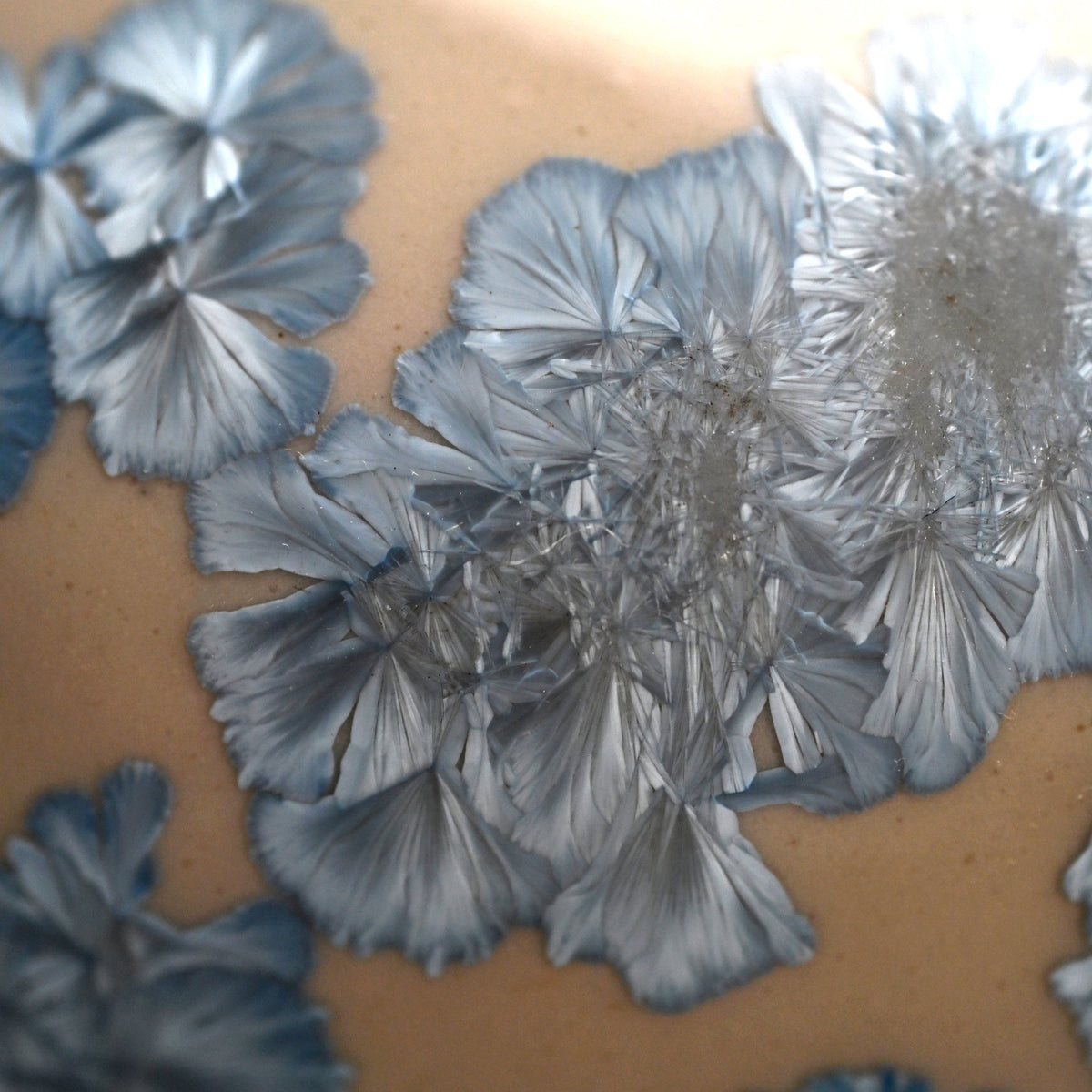
I have never seen another work like this by important artist Kiyomizu Rokeubei V. Volumes could be written on the powerhouse who assumed the title of the fifth generation of this iconographic Kyoto family. His influence is so pervasive he was voted one of the most important potters of the modern era by Honoho magazine, the preeminent quarterly devoted to Japanese pottery. This vase is again evidence of the breadth of his experimentation, knowledge and mastery of ceramic styles. The hybrid traditional form is covered in ivory glaze upon which metallic blue crystals blossom into a mad landscape. It is 20 cm (8 inches) diameter, 30.5 cm (12 inches) tall and in perfect condition, clearly bearing the artist’s seal impressed into the clay of the base.
Kiyomizu Rokubei V (Shimizu Kuritaro, 1875-1959) like his father before him, first learned painting and decorating technique under Kono Bairei, one of the foremost painters in Japan in the Meiji era. After graduating the Kyoto Municipal Special School of Painting, he took a position under his father at the family kiln however maintained his painting studies under Bairei as well, and after the death of Bairei in 1895, continued under his successor Takeuchi Seiho. That same year he exhibited his first work at the National Industrial Exposition. He was a co-founder of Yutoen with his father and Asai Chu, and worked ceaselessly to promote the pottery of Kyoto. He helped to establish the Kyoto Ceramics Research Facility (Kyoto Tojiki Shikensho) at the turn of the century which would later be the birthplace of another Kyoto Legend, Kawai Kanjiro (and in fact Kanjiro would acquire the Rokubei family Kiln in 1920). Doctor Maezaki Shinya has noted that Teishitsu-Gigei-in (Imperial Art Academy Member) Seifu Yohei III also fired his acclaimed works in the Rokubei kiln in the Taisho era. Due to his father’s poor health Rokubei V took the reins unofficially in 1902, commanding the helm until assuming the name Rokubei V in 1913, the second year of the Taisho period. With the increased interest and ability to travel in Asia, traditional continental ceramics, which had long been held in high esteem, inspired deep research into reviving forms, glazes and techniques. Artists such as Suwa Sozan, Tomimoto Kenkichi and Miura Chikusen as well as, again, our protagonist Rokubei, were on the forefront of this movement and enjoyed great favor among the educated and scholarly classes. Rokubei V was entirely unbound by any one genre. He mastered traditional Gohon glazes, Gosu glazes, celadon and Hakuji/kiji porcelain, Sometsuke and Yukasai under glaze design, over glaze enamels, Tetsu-e iron glaze, Sansai Tri-color ware, Yuteki and tenmoku Oil Spot techniques, unglazed Yakishime Shigaraki, Iga, Mushiake and Nanban, long established Kyoto Kenzan, Ninsei and Raku wares. He carved into the surface, created raised designs, inlayed, sculpted, coiled, threw, dribbled and splashed and dripped and drew…indefatigable. Extremely traditional Maccha tea ware to ultra-modernist styles, and he did all this between 1900 and 1930. As well he developed a unique pink and white glazing technique called Taireiji. Later in the era Art Deco would hit Japan and inspire artists like Kusube Yaichi and Ito Suiko with sleek lines and abstract compositions, and again, Rokubei was there. It was in 1928 that Rokubei changed the reading of the family name from Shimizu to Kiyomizu and applied it retroactively to previous generations. He exhibited constantly, and garnered a great many awards. He worked to get crafts added to the National Art Exhibition (Bunten/Teiten) and served as a judge in 1927, the first year crafts were allowed. In 1937 he was designated a member of the Imperial Art Council (Teishitsu Bijutsu Inkai). He retired in 1945, passing the name Rokubei to his son and took the retirement name Rokuwa. Uncontainable he continued to create pottery under that name until his death in 1959. A multitude of works by him are held in the The National Museums of Modern Art, both in Tokyo and Kyoto, the Kyoto Kyocera Museum, The Kyoto Hakubutsukan Museum and the Philadelphia Art Museum among others.