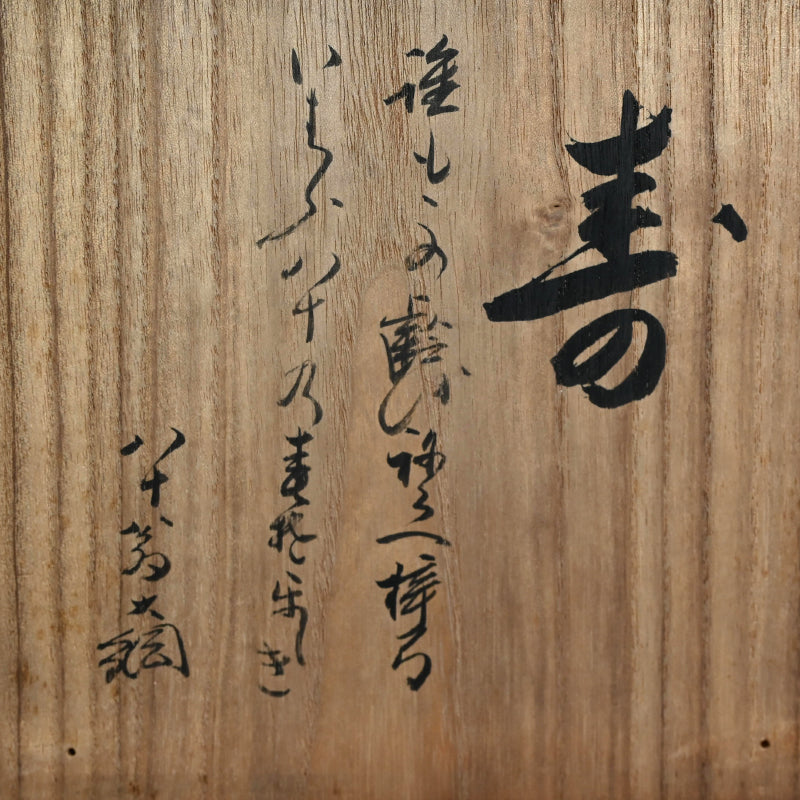
A porcelain fresh water jar for use in the Japanese Maccha Tea Ceremony by Edo period Kyoto potter Kisuke decorated with a pine shaded temple gate among the clouds by Zen Master Taiko (Daiko) Sogen. Atop the lid, serving as a handle, is a large bumble bee, and inside it is dated early spring of Kaei 4 (1851) and signed the 80 year old Taiko as well as Kisuke-Zo. The wooden box is titled Ko-sometsuke Utsushi Un-Do Mizusashi and signed outside Yakimonoshi Kisuke followed by a stamp and signed by the 80 year old man Taiko inside. The receptacle is 17 cm (7 inches) diameter, 15.5 cm (6 inches) tall and in excellent condition.
Taiko Sōgen (also Daiko, 1772–1860) was a distinguished Zen priest of the Edo period, serving as the 435th abbot of Daitoku-ji and the 14th abbot of its sub-temple, Ōbai-in. Entering monastic life at Ōbai-in at the age of six, he trained under Yūtani Sōtsū, and in 1820 ascended to the abbacy of Daitoku-ji. Renowned for his refinement in waka poetry and the tea ceremony, he maintained close ties with the heads of the Urasenke, Omotesenke, and Mushakōji Senke lineages, as well as with leading court nobles such as Takatsukasa Masamichi, Konoe Tadahiro, and Kujō Hisatada. He was also connected to the tea practitioner and wealthy merchant Matsumura Sōetsu of Echigo, and played an important role as Zen teacher to Eiraku Hōzen, the celebrated Kyoto potter who began his early training under him at Ōbai-in. His writings include the diary Kūkashitsu nikki and the poetry collection Daikō i’ei, which contains his well-known verse likening human life to bubbles upon the Yodo River. Many of his calligraphic works, inscriptions, and poetic paintings survive, testifying to his enduring influence on the cultural world of Zen and chanoyu.