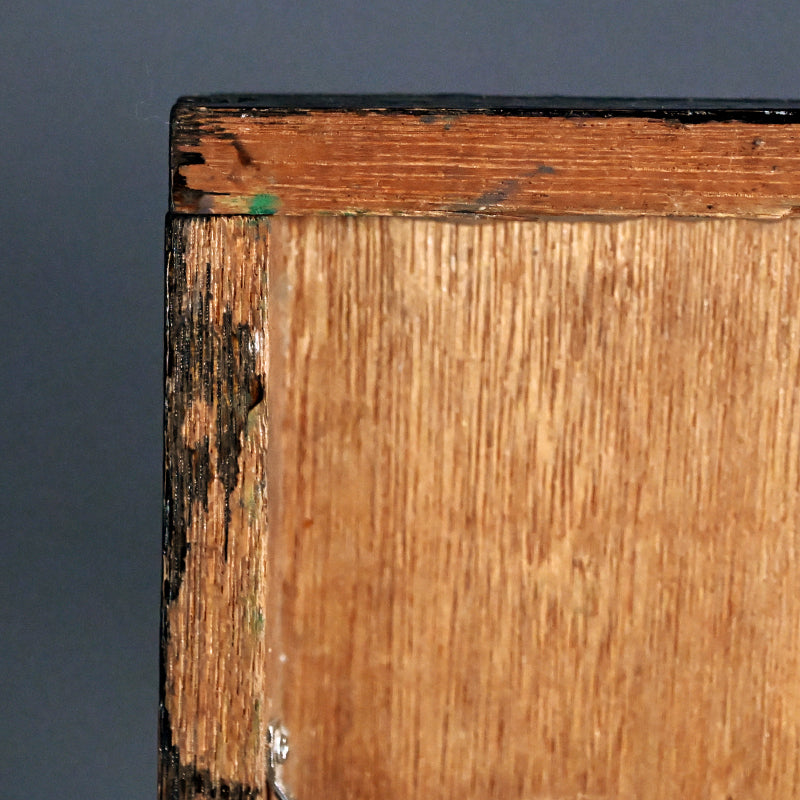
An early Mixed media collage made up of Shikei paper printing molds covered in thick dark color dating from the 1950s. Certainly speaking for its time, Micky Mouse directs the scene, along with automobiles, architecture, what appears to be rows of vending machines and other future fossils of our world as it was at that time. A most intriguing work mounted on wood panel. It is 30.3 x 45.5 x 4 cm (12 x 18 x 1-1/2 inches). There is wear to some of the high edges, typical of age, and a scratch in the right center of the panel.
Nomura Ko (1927–1991) was born in Kyoto and graduated from the Nihonga Department of Kyoto Municipal College of Art in 1948. In 1950 he joined the Pan Real Art Association (until 1965), establishing himself as a significant figure in the postwar avant-garde movement in Japanese-style painting. Initially influenced by Surrealism, he shifted in the later 1950s toward abstraction and collage, employing unconventional materials such as newspaper printing molds, industrial waste, slate, and cement. From the mid 60”s he was driven beyond the framework to be a pioneer in installation exhibition, creating one-time works which allowed the room to be the frame. Through materially driven works and these later three-dimensional and spatial constructions, Nomura fundamentally redefined the physical and conceptual boundaries of Nihonga. His major exhibition history includes the aforementioned Pan Real (1950-1965), the Asahi New Artist Exhibition, the Asahi Selected Exhibition and the Contemporary Japanese Art Exhibition. Trends in Contemporary Painting (1963), and Today’s Artists ’64 (1964). From 1978 onward, he participated almost annually in the Ge Exhibition. In 1986, he was featured in A Section of Postwar Nihonga at Yamaguchi Prefectural Art Museum. A major retrospective, Kyoto Art: Yesterday, Today, Tomorrow III – Nomura Ko, was held at Kyoto City Museum of Art in 1989. His work was posthumously included in The Turning Point of Postwar Nihonga at Tochigi Prefectural Museum of Fine Arts in 1993, confirming his pivotal role in transforming postwar Nihonga. Work by him is held in the collections of The Kyoto National Museum of Modern Art, Fukui Fine Arts Museum, Kariya City Art Museum, Kyoto City Kyocera Museum of Art, Meguro Museum of Art in Tokyo, Nara Prefectural Museum of Art, Osaka Nakanoshima Museum of Art, Osaka Prefectural 20th Century Art Collection, Tochigi Prefectural Museum of Art, Toyohashi City Museum of Art, Wakayama Museum of Modern Art, Yamaguchi Prefectural Art Museum, Sakuragaoka Museum, The, Kyoto University Art Museum and Kyoto City University of Arts among others.