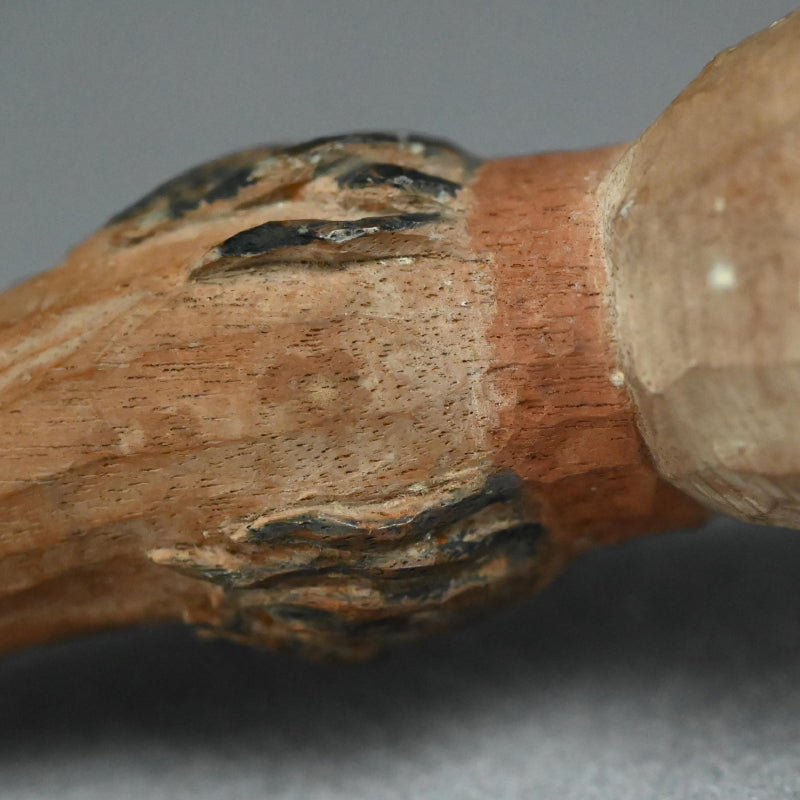
A pair of frogs climb aboard a lotus root forming this gentle sculpture by Miyamoto Risaburo carved from camphor wood with light coloring. The artist’s signature is engraved into the base. The composition combines naturalism and humor: the frogs, rendered in mottled green and russet tones with black markings and golden eyes, are poised in lifelike attitudes, their limbs tensed as if ready to leap. The lotus root, carved from a single piece of wood, retains the texture of the natural material—its irregular surface suggesting both the organic contours of the plant and the sculptor’s chisel marks. Near one end, the form transitions into the suggestion of root fibers, carved and darkened for contrast, giving the impression of a recently unearthed rhizome. Despite its modest scale, the piece demonstrates remarkable sensitivity to both subject and medium. The frogs’ alert expressions and delicate polychrome detailing reveal the artist’s close observation of living creatures. It is 33 x 5.5 x 7 cm (roughly 13 x 2 x 3 inches) and is in overall excellent condition, with some toning and accumulation typical of age and exposure to air.
Miyamoto Risaburo (1904–1998) was a Japanese sculptor active from the Taisho through the Showa periods, acclaimed for his finely carved animal and human figures rendered with both vitality and tenderness. Born with an early passion for art, he moved to Kyoto to study under Mitani Kogetsu and later continued his training in Tokyo with Sato Chozan. His career was launched with Red Frog (Aka-gaeru), exhibited at the 14th Japan Art Institute Exhibition in 1929, which brought him national recognition. In his early years, he specialized in small animal sculptures—frogs, ducks, and shrikes—regularly shown at the Institute’s exhibitions, before transitioning to human subjects with Mother and Child (1938), followed by expressive works such as Child, Portrait of Master Hiragushi, and Seated Boy. After World War II, he held a successful solo exhibition at Matsuzakaya in Ueno (1948), maintaining the refined aesthetic spirit of his teacher Hiragushi Denchū while engaging with new postwar directions in sculpture. From the late 1960s onward, Miyamoto increasingly focused on Buddhist imagery, creating major works such as Fudo Myoo and the Enma Daio statue at Hojoin Temple in Fukagawa. Renowned for his exceptional command of wood carving and his ability to imbue his figures with both physical immediacy and quiet spirituality, Miyamoto continued to produce until his death at age ninety-four