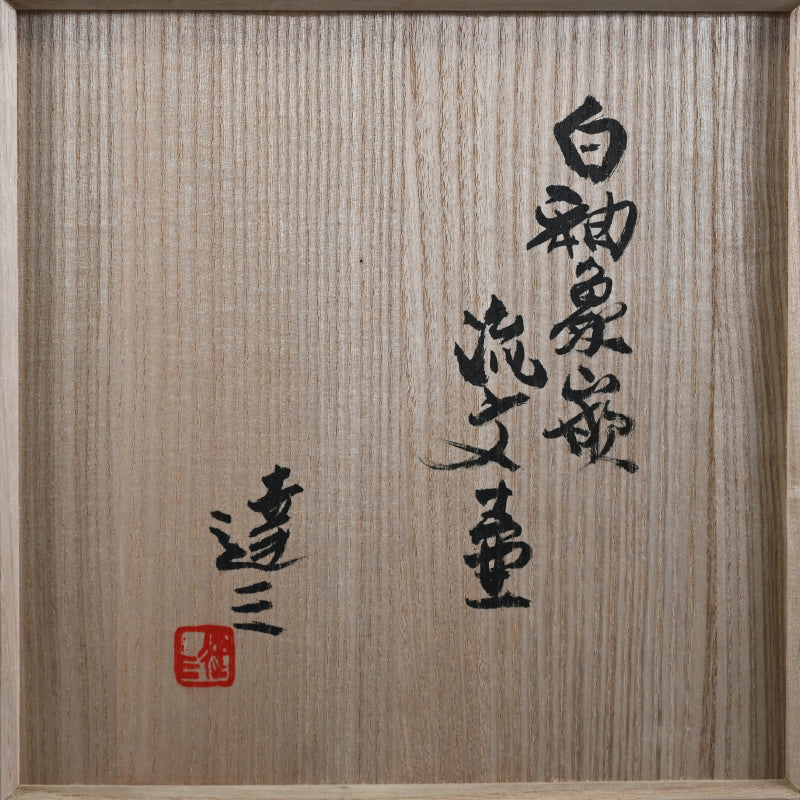
An expressive tsubo by Living National Treasure Shimaoka Tatsuzō, enclosed in its original signed wooden box titled Haku-yū Zōgan Nagashimon Tsubo. The full, rounded vessel is covered in a softly luminous blue-white glaze through which Shimaoka's characteristic rope-impressed pattern remains visible, creating a quiet rhythmic texture across the surface. Against this ordered ground, broad iron-rich designs flow freely around the body in sweeping concentric forms, their dark olive-brown passages feathering and dissolving into the surrounding glaze. On the reverse, a softer wash of green and pale violet forms another loosely circular motif, giving the vessel distinctly different expressions as it is turned. The contrast between the disciplined repetition of the impressed ground and the spontaneous, almost calligraphic movement of the flowing glaze is particularly effective, lending the substantial form a sense of movement and depth. The mouth and foot are defined by concentric rings, with warm reddish clay exposed beneath the foot. It measures 23.5 cm (9-1/4 inches) in diameter, approximately the same in height, and is in excellent condition.
Shimaoka Tatsuzo (1919-2007) was born in Tokyo and enrolled in the Tokyo Kogei Daigaku Ceramics division in 1939. The following year he would meet Mashiko Mingei potter Hamada Shoji, and the course of his life was thought set, graduating in 1941. However, he was drafted in 1942, and sent to Burma where he would remain until repatriation after the cessation of hostilities. In 1946 Tatsuzo apprenticed under Hamada who encouraged him to find his own voice, which he did when in 1950 took part in research into ancient Jomon potteries with Shirasaki Shunji, which would have a profound influence on his style. Working with Jomon rope patterns, Tatsuzo set out to create a style unique to himself, establishing his own kiln in 1954. Widely exhibited, awarded and influential in his lifetime, he received the Japan Ceramic Society Gold award in 1994, one of the highest honors for a Japanese ceramic artist, and was designated a Living National Treasure (Juyo Mukei Bunkazai or Ningenkokuho) in 1996 culminating with receiving the Order of the Rising Sun in 1999.