Note:
Since this product is an oversized item that requires custom shipping, please send us a message with the delivery address and we will come back to you with a shipping quote.
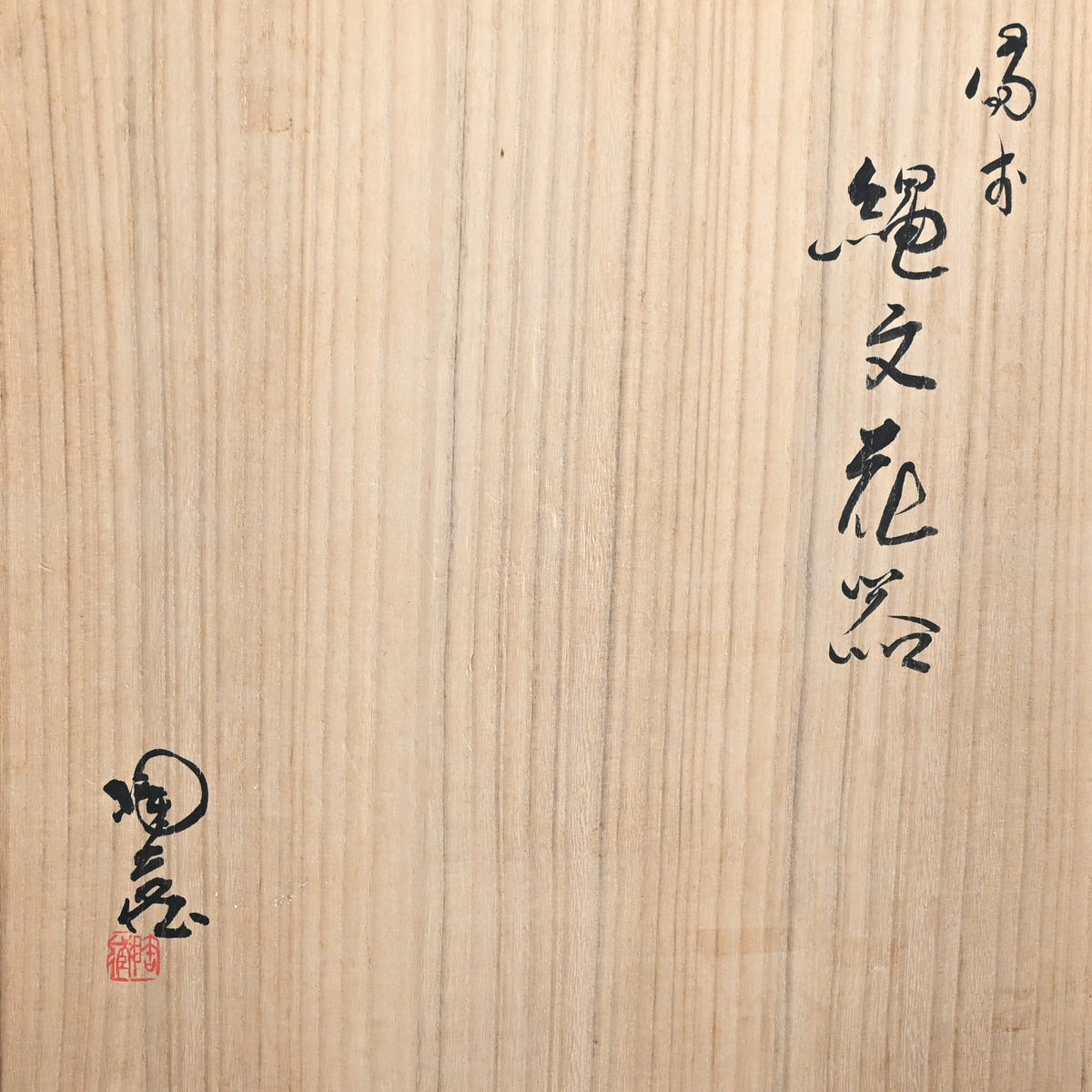
A powerful sculptural Bizen flower vessel by Konishi Tōzō, its rounded body enveloped by deeply modeled bands that coil and sweep across the surface like lengths of ancient rope. Titled Bizen Jōmon Kaki, the work draws directly upon the visual language of Japan’s prehistoric Jōmon culture, whose very name—“cord-marked”—derives from the impressions of twisted fiber pressed into the surfaces of ancient earthenware. Konishi does not simply reproduce Jōmon decoration, however. Here the cord has become monumental: broad raised ridges travel continuously around the vessel, bending, converging and changing direction as they respond to its swelling form. Seen from different angles, the pattern alternately suggests rope, geological strata, flowing water, or the growth rings of an immense piece of timber. At the top, the successive bands tighten concentrically around an irregular opening, giving the impression that the vessel has been built inward layer by layer. The rich Bizen clay ranges from deep reddish brown to iron black and warm ochre, with the projecting ridges catching the effects of the firing while the recessed channels retain darker tones. Particularly striking is the contrast between the almost primordial roughness of the fired surface and the extraordinary deliberation of the construction. At 34 x 33 x 34 cm (13-3/8 x 13 x 13-3/8 inches), the vessel has a substantial physical presence, yet the continuous movement of its surface prevents the mass from becoming static. It is at once unmistakably a Bizen vessel and something approaching sculpture: a contemporary work rooted in one of the oldest ceramic traditions of the Japanese archipelago.
Due to size the cost of shipping will be accrued separately.
Konishi Tōzō was born in 1947 in Bizen City, Okayama Prefecture, into the heartland of one of Japan's celebrated Six Ancient Kilns. He was first selected for the Japan Traditional Art Crafts Exhibition (Nihon Dentō Kōgeiten) in 1971 and received an award at the 3rd Chunichi International Ceramic Art Exhibition in 1975, the beginning of a career marked by numerous honors. In 1988 he received the prestigious Kaneshige Tōyō Award, named for the great twentieth-century master responsible for the modern revival of Bizen ware. While deeply grounded in Bizen's unglazed stoneware tradition and its transformation of iron-rich clay through wood firing, Konishi has consistently explored forms and surface treatments that move beyond conventional vessel types. His work was included in the 1997 exhibition Bizen: A Thousand Years of Traditional Beauty at the Musée National de Céramique in France, and examples of his ceramics have entered international collections including the Art Gallery of New South Wales in Australia and the Brooklyn Museum in New York.