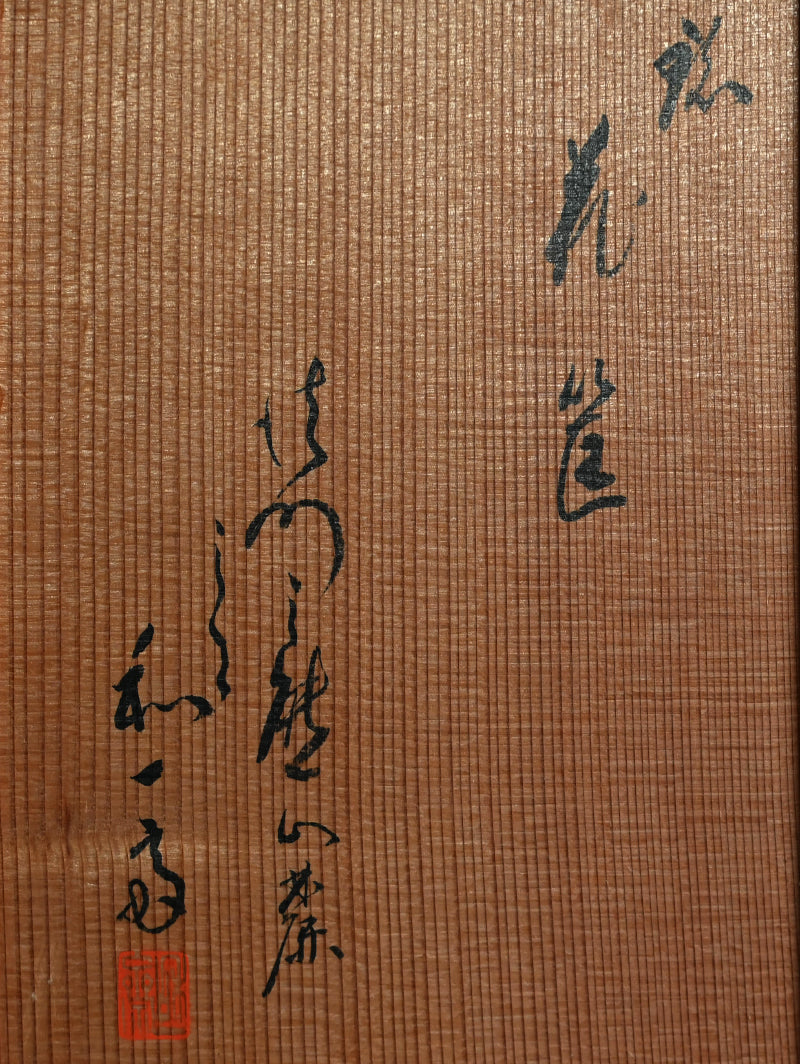
A bamboo kago basket in the shape of a Rokkaku Tetsuki yorodai (Six-sided handled Brazier carrier) by Wada Waichisai III enclosed in the original signed wooden box. It is 22 x 19.5 x 58 cm (just less than 2 feet tall) and is in excellent condition.
Wada Waichisai I (1851–1901), born Ichimatsu in Osaka, began his career humbly, crafting utilitarian baskets for farmers—a tradition passed down from his father. Initially working under the studio name Chikuunsai. Encouraged by scholars and connoisseurs of the tea ceremony, he transitioned from rustic function to refined form, becoming a specialist in elegant flower baskets (hanakago) made from bamboo. His work gained national attention when he was awarded First Prize at the 2nd National Industrial Exhibition in 1881. A decade later, in 1894, one of his baskets was presented to Emperor Meiji on the occasion of the Emperor’s silver jubilee anniversary at Sumiyoshi Shrine in Osaka. So impressed was Prince Konoe Tadahiro by its craftsmanship that he conferred upon Ichimatsu the name Waichisai, meaning "First in Japan." As a teacher, Waichisai I mentored many who would become masters in their own right, including Tanabe Chikuunsai I. Alongside Donkosai of Namba and Shōkosai I of Semba, he is remembered as one of the three great bamboo masters of the Meiji era and a pivotal figure in elevating the art of basketry in Osaka.
Wada Waichisai II (1877–1933), son of Waichisai I, carried the family legacy into the 20th century. Following the death of his father, he relocated the family from urban Osaka to Arima, a nearby hot spring town in Hyōgo Prefecture known for its long-standing traditions in bamboo craft. There, he continued refining the family’s artistic voice in bamboo, maintaining the reputation and quality established by his predecessor. <br>
Wada Waichisai III (1899–1975), born Shigekazu, was the eldest son of Waichisai II (Wada Shikazo). Trained by his father and first known under the art name Issai, he quickly distinguished himself, winning Best of Show at the Osaka Art Exhibition at just 25. Upon his father’s passing in 1933, he assumed the name Waichisai III and continued to gain acclaim, with works entering the collection of the Imperial Household. However, the trajectory of his career was dramatically altered by the devastation of World War II. He lost both his family home and his only heir during the bombing of Kobe and eventually resettled on Awaji Island, where he quietly continued his work.