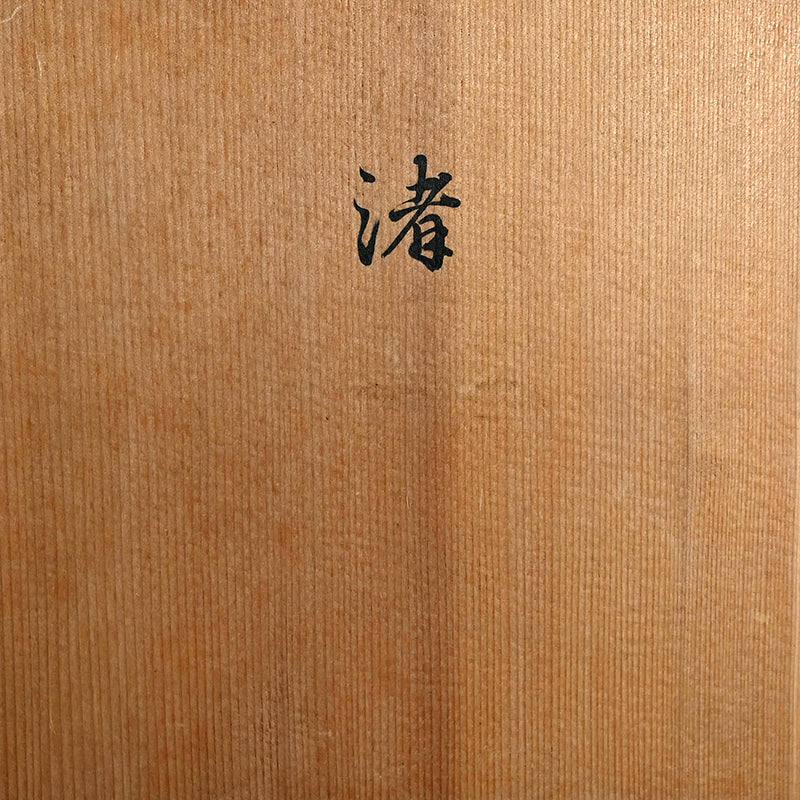
A woven basket of white bamboo by Hayakawa Shokosai V enclosed in the original signed wooden box titled Nagisa. Nagisa describes a shoreline or place where the waves come in; the water’s edge. Often in traditional Japan, boulders were bound in bamboo cages and used as breakwaters. It is likely the artist was referring to this in his title. Signed on the base, the vessel is 19 cm (7-1/2 inches) 28 cm (11 inches) tall and in excellent condition. The bamboo insert has cracked with time.
Hayakawa Shōkōsai V (1932–2011) was born in Osaka as the eldest son of the fourth-generation Hayakawa Shōkōsai and later relocated to Kyoto, carrying forward one of Japan’s most distinguished bamboo-art lineages. His given name was Shūhei, and over the course of his career he used a number of seals and art names, including Shōkō, Shōkōsai, “Fifth-Generation Bamboo Craftsman Shōkōsai,” and Shū. In 1951 he began formal training under his father and initially worked under the names Shōha and Shōkō. He made his public debut as a bamboo artist in 1965 with his first solo exhibition at Osaka Mitsukoshi under the name Hayakawa Shōkō, an event that proved pivotal: through it he formed a relationship with the kettle maker Kakutani Ikkei, a Living National Treasure, who recognized his talent and encouraged his participation in the exhibitions of the Japan Traditional Crafts Association from the following year. From his first submission and acceptance in 1966, Hayakawa was selected every year thereafter, becoming a full member of the Japan Kōgei Association in 1968 and receiving the Association’s Encouragement Prize at the Japan Traditional Crafts Exhibition in 1976. Following his father’s death in 1977, he formally succeeded to the name of the fifth-generation Shōkōsai. Deeply grounded in the Hayakawa family tradition, he skillfully alternated between inherited plaiting (ami) and assembling (kumi) techniques, while also developing an original fifth-generation method known as kirikomi sukashi monyō, in which wide bamboo strips are partially cut to create openwork patterns; this technical breadth and inventive range earned him wide acclaim. Alongside his domestic career, he actively introduced Japanese bamboo art abroad, holding solo exhibitions and workshops in the United States and presenting exhibitions in Europe, including at the British Museum. In recognition of his achievements, he was designated a Holder of the Kyoto Prefectural Intangible Cultural Property for Bamboo Craft in 1992, received the Excellence Prize (Holder’s Award) at the Japan Traditional Crafts Exhibition in 1996, the Kyoto Prefectural Culture Award for Meritorious Service in 2002, and in 2003 was named a Holder of the Important Intangible Cultural Property “Bamboo Craft,” becoming a Living National Treasure. Hayakawa Shōkōsai V passed away on December 7, 2011, at the age of 79, leaving behind a body of work that balances tradition and innovation through techniques ranging from exquisitely precise weaving to freely expressive coarse structures, and that brings forth the inherent vitality of bamboo in works that are at once pure, dignified, and powerfully substantial, firmly establishing a contemporary expression within a classical lineage.