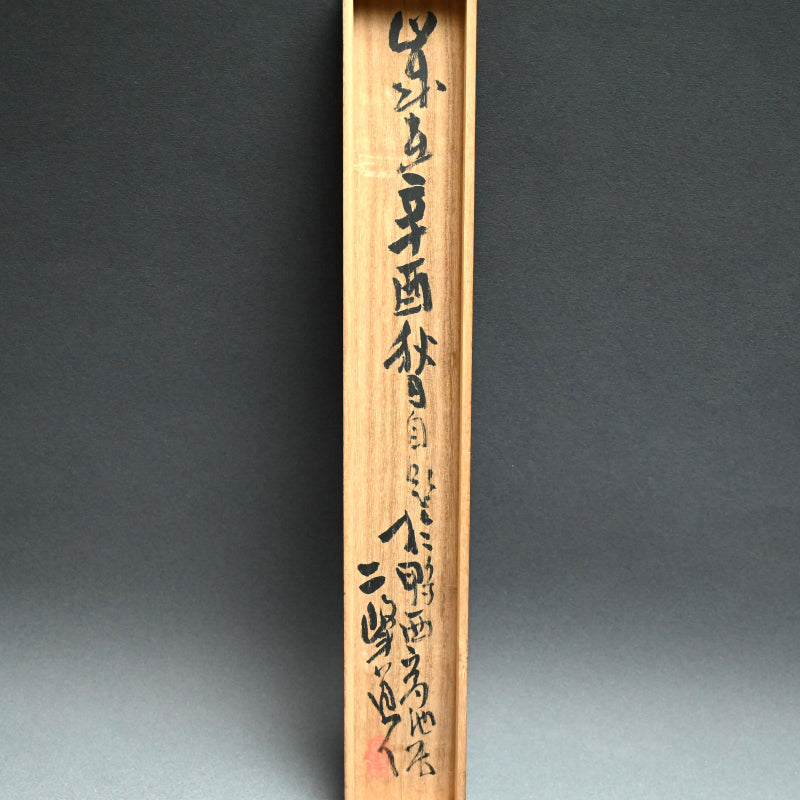
In this richly atmospheric hanging scroll, Shirakura Niho evokes the inner world of the Japanese literati ideal: the solitary scholar in quiet dialogue with nature. Niho’s freely brushed textures, selective use of color, and expressive ink tonality reveal his mastery of Nanga (literati) aesthetics while rendering a work distinctly modern and vibrant. The scroll is enclosed in the original signed wooden box dated an Autumn day in 1921 titled Shokei Yutsu (Among the Pines, a Subtle Communion). Ink and light color on paper in a fine patterned silk border with turned black-wood rollers. The scroll is 47 x 199 cm (19 x 78-1/2 inches) and is in overall fine condition.
The scene unfolds in a deep mountain ravine, where sheer ink-washed cliffs rise like darkened clouds. Their mottled surfaces, rendered through layered washes and textured strokes, create the impression of a landscape half-seen through drifting mist—an otherworldly realm where vision and imagination merge. Amid this shadowed terrain stands a cluster of ancient pines, their trunks articulated in warm russet tones and their needled branches sharply picked out in black. These “pine lines”—matsu-kei—form the vertical structure of the composition and give the painting its title: they are the steadfast presences through which the hidden resonance (yutsu) of the natural world is perceived. Their twisting boughs frame a moonlit opening in the distant cliffs, suggesting a cosmic passageway through which spirit and scenery subtly commune. Nestled among the trees, a red-lacquered pavilion clings to the mountainside, its rhythmic posts and patterned balustrades offering a striking contrast to the surrounding monochrome ink. Inside, a solitary figure—robes softly toned in blue and white—leans against a circular table, suspended in contemplation. She is neither reading nor writing, but simply being, embodying the literati ideal of effortless communion with one’s surroundings. The pavilion’s open design allows nature to flow through it: moonlight filters across the floor, pines encircle its perimeter, and the figure is as much a part of the landscape as the rocks and trees themselves. Below, jagged stones and a cavernous cleft extend downward in swirling strokes of deep ink, grounding the composition and lending it a dramatic sense of depth. The entire scene communicates the Daoist-inflected idea that the scholar’s mind and the natural world correspond in silence—that the pines, cliffs, and moon reveal their inner truths only to one who sits still enough to listen.
Shirakura Kinichiro (Niho or Jiho, Kanyu, 1896-1974) was born in Niigata, and initially was inducted into Nanga under Hatta Goro. Moving to Tokyo he began studies of Western oil painting following Ishii Hakutei. However, that was unfulfilling, and he soon moved to Kyoto, returning to the Nanga style under Tanabe Chikuson (also Tajika/Tachika Chikuson, 1864-1922). Following the death of Chikuson, he moved to Tokyo where he took up residence in the studio of Komura Suiun. He was consistently displayed at both the Teiten-Nitten National Exhibitions as well as the Nihon Nanga –In Ten. Like other individualistic artists of his generation, he was known for his very unique and easily discernible style and enjoyed immense popularity. He later changed his name to Kanyu. He was recognized in an English book published in 1958 as one of the most important artists to visit when in Japan.