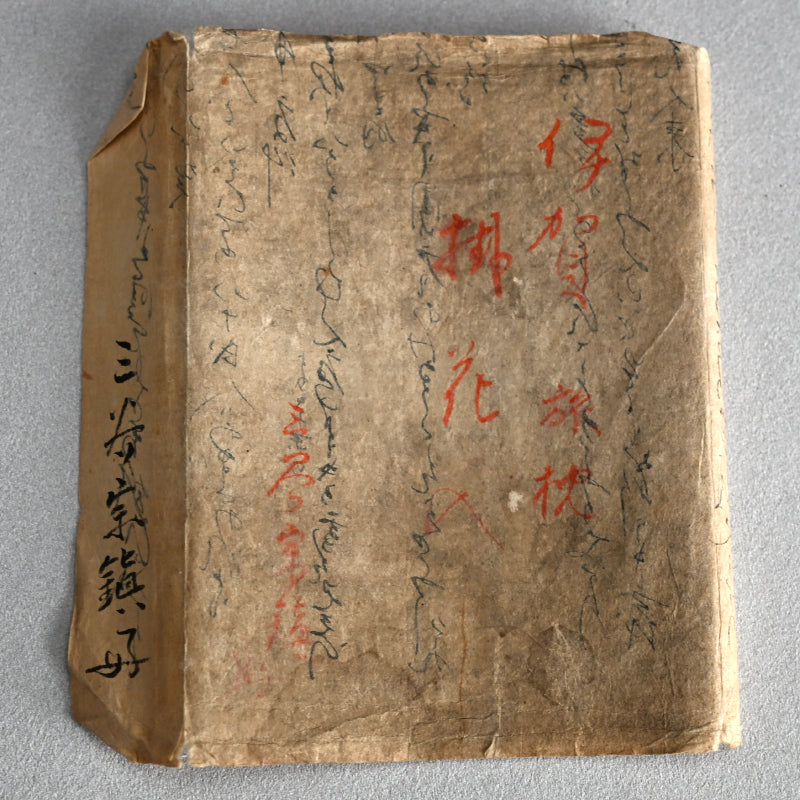
A gnarled Iga vase deeply scored and blasted on the fire-side with igneous molten glaze, charred and viscous at the rim, flowing down in ocher and green to blue then black around the base. Impressed into the sides are box-like shapes, and it is signed on the back in red lacquer by a tea master. The signature appears to be that of Yamada Sohen (1627-1708), of the Sohen Tea School. It comes enclosed in an ancient wooden box attested to by the same tea master and titled Iga Tabi-Makura (Iga Traveling pillow), a reference to the indented shape. The vase dates from the Momoyama to early Edo period. It is 10 x 7.5 x 14.5 cm (4 x 3 x 6 inches) and is in excellent condition. A paper cover letter titled in red Iga Tabi Makura Kake Hana is noted on the side as being the preference of Mitani Sochin (Mitani Shochin Konomi).
Yamada Sōhen (1627–1708) was an early Edo period tea master and founder of the Sōhen school of tea ceremony. Born at Chōtoku-ji temple in Kyoto as the son of its abbot, he initially inherited the priesthood before renouncing it to pursue tea, studying first under Kobori Enshū and then becoming a disciple of Sen Sōtan, from whom he received full transmission. In 1655, through Sōtan’s recommendation, he entered service as tea master to Ogasawara Tadatomo in Mikawa Province (present-day Toyohashi), where he served for over forty years while establishing teahouses and deepening his Zen practice. Granted the rare privilege of using the hermitage names associated with both Sen no Rikyū and Sōtan, he later retired to Edo in 1697, settling in Honjo and formally founding the Sōhen-ryū. There he moved within elite cultural circles, including attending gatherings at the residence of Kira Yoshinaka. He died in Edo at the age of eighty-two, leaving behind a distinct tea lineage and written works such as Chadō Benmōshō and Chadō Yōroku.
Mitani Sōchin (1665–1741) was a tea practitioner of the mid-Edo period originally from Harima Province (present-day Hyōgo Prefecture) who studied Confucianism under Itō Tōgai, and in tea was a disciple of Sen Sōsa VI of the Omotesenke tradition, counted among the “Four Heavenly Kings” of his circle. He served the Asano clan of Aki Province in the capacity of Confucian scholar, and was appointed tea master in attendance at their Kyoto residence. He died on the 12th day of the 5th month of Kanpō 1 (1741) at the age of 77. His personal name was Yoshikata; his courtesy name (azana) was Ryōboku; his common name was Tange. He also used the art name Nanshishi, among others. He is remembered for his writings, including the widely circulated Wakan Chashi (“A Record of Tea in Japan and China”).