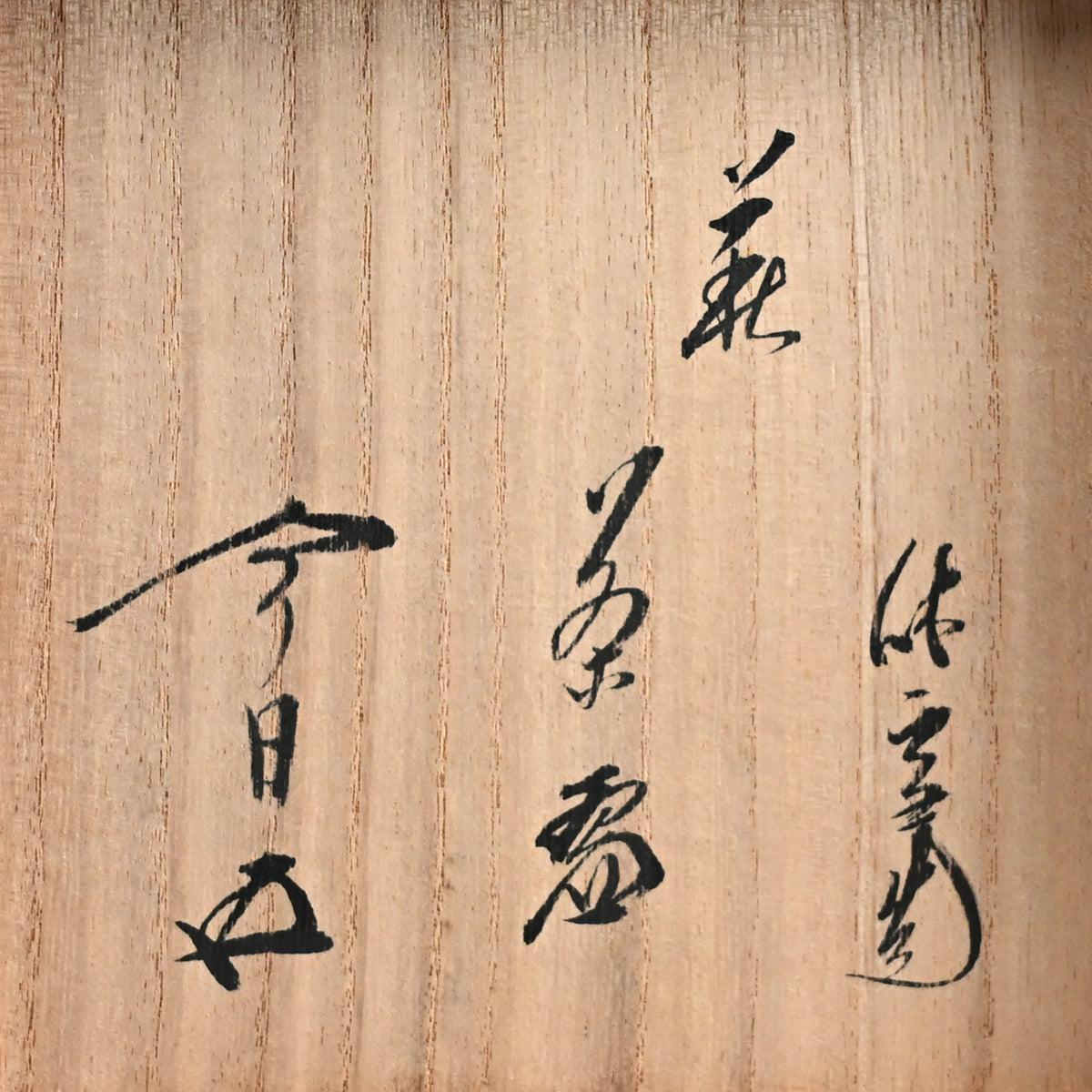
Crawling white frothy glaze reveals pockets of the raw earth forming this quietly powerful tea bowl by Living National Treasure Miwa Kyusetsu XI (Jusetsu), enclosed in its original wooden box with an inscription by Urasenke XV Grand Master Sen Genshitsu Hōunsai titled Shiro-Hagi Chawan. The generously rounded form rises from a small foot to an irregular, gently undulating rim, its surface enveloped in a soft white Hagi glaze. Fine crazing spreads across the milky surface, punctuated by pinholes, iron specks and scattered areas where the glaze draws back to reveal the warm reddish clay beneath. These darker interruptions are particularly effective along the lip, emphasizing its wavering profile, while the exposed clay around the foot provides an earthy counterpoint to the pale body above. Substantial yet remarkably restrained, the bowl derives its character from the subtle tension between luminous white glaze, rough clay and the natural effects of firing. It measures 14 cm (5-1/2 inches) in diameter, 9 cm (3-1/2 inches) tall and is in perfect condition.
Miwa Kyusetsu XI (1910-2012) was born the third son of the ninth generation Miwa Kyusetsu (Setsudo) and studied under his father and older brother (Kyusetsu X: Kyuwa). He also studied under Kawakita Handeishi. He was first exhibited in 1955, and garnered his first acolades at the 4th Natioanl Traditional Craft Exhibition (Nihon Dento Kogei Ten) in 1957. Following the retirement of the 10th generation Kyusetsu, he succeeded the name in 1967. He received the Imperial Order with Purple Ribbon in 1976 and the Order of the Sacred Treasure in 1982. He was acknowledged as a Yamaguchi Prefectural Preserver of Intangible Cultural Properties in 1972 and Designated Living National Treasure in 1983. He officially retired, passing on the family name and mantle to Miwa Ryusaku, but continued making pottery under the name “Jusetsu”.
Hōunsai Sen Genshitsu (1923–2025) was the fifteenth-generation Grand Master of the Urasenke tradition of tea and one of the most influential figures in the international development of chanoyu in the modern era. Born in Kyoto as Sen Masaoki, the eldest son of the fourteenth Grand Master, Mugensai, he studied at Doshisha University before being called into the Imperial Japanese Navy during the Pacific War, where he served in a special attack unit but survived the war without being ordered on a final mission. He later undertook Zen training at Daitokuji and received the name Hōunsai from the Zen master Gotō Zuigan. In 1964 he succeeded his father as the fifteenth Urasenke Grand Master, assuming the hereditary name Sen Sōshitsu. During his thirty-eight years as head of the school, Hōunsai worked tirelessly to introduce the Way of Tea internationally, traveling more than three hundred times to over sixty countries and promoting his lifelong ideal of “Peacefulness through a Bowl of Tea” (Ichawan kara Peacefulness o). He received the Order of Culture in 1997 and served in numerous international cultural and diplomatic roles, including as a UNESCO Goodwill Ambassador and Japan–United Nations Goodwill Ambassador. In 2002 he passed the position of Grand Master to his son, the sixteenth-generation Zabōsai, thereafter taking the name Sen Genshitsu and the title of Grand Master Emeritus (Daisōshō). He continued to promote tea as a means of cultural understanding and peace until his death in 2025 at the age of 102.