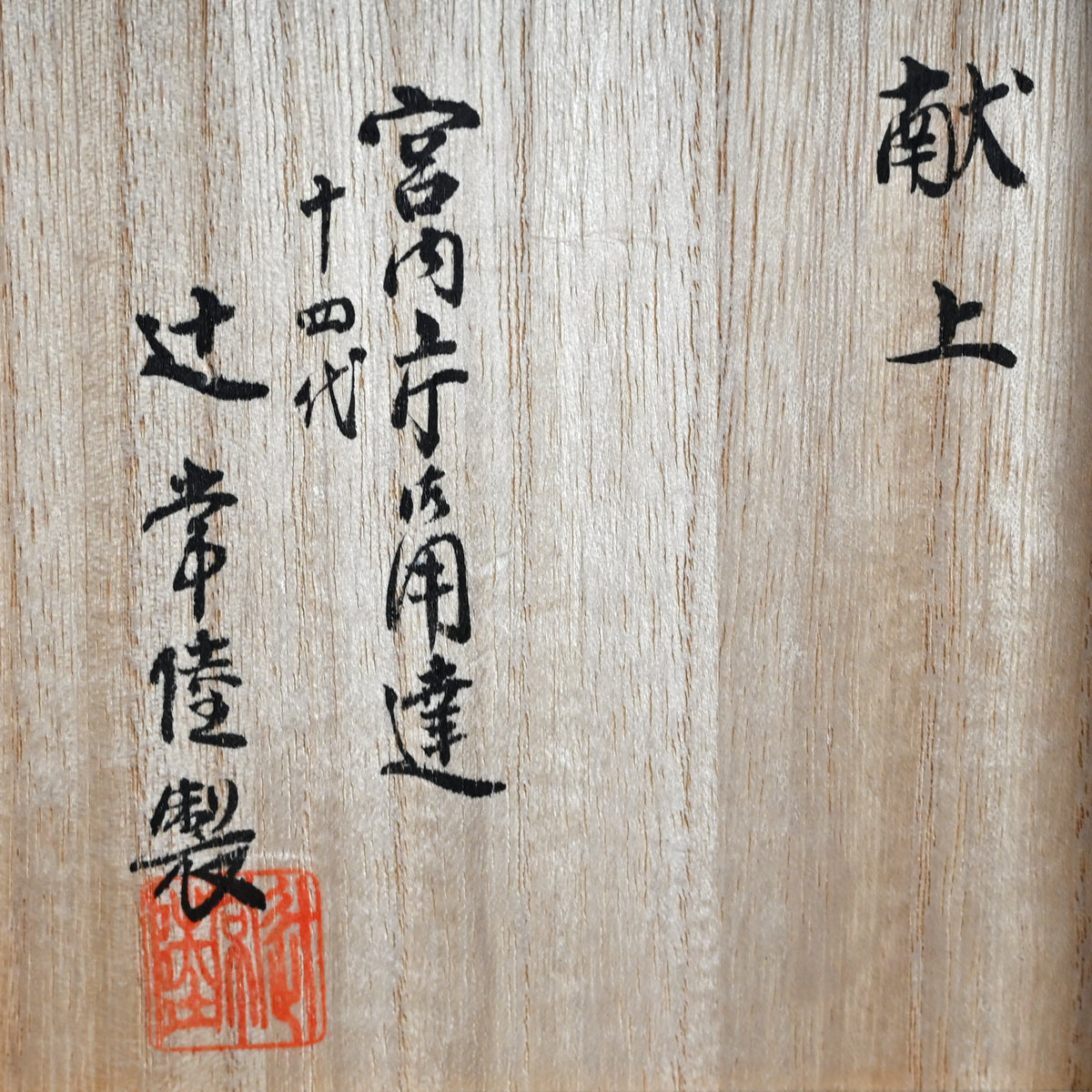
A superb blue-and-white porcelain vase by Tsuji Hitachi XIV (1909–2007), enclosed in the original signed wooden box titled Sometsuke Hatō Unryū-mon Tsurukubi Kabin, or “Blue-and-White Crane-Neck Vase with Dragon amid Clouds and Waves.” The elegant pear-shaped body rises to a long slender neck and flared mouth, providing a graceful field for a remarkably detailed dragon twisting through dense banks of scrolling clouds above turbulent waves. Painted entirely in underglaze cobalt, the design moves between deep saturated blue and softly washed passages, while areas of brilliant white porcelain open between the clouds and coils of the dragon, lending the composition considerable depth and movement. Particularly fine are the individually articulated scales, claws, whiskers and expressive face of the dragon. A narrow key-fret border encircles both foot and mouth, neatly containing the otherwise energetic decoration. The original box bears a label indicating presentation through the Imperial Household Agency purveyor, and is accompanied by material from Tsuji's eighty-eighth-birthday exhibition at Tenmaya Fukuyama. It is 12 cm (4-3/4 inches) diameter, 22.5 cm (8-7/8 inches) tall and in excellent condition.
Tsuji Hitachi XIV (1909-2007) was a highly distinguished Japanese ceramic artist and the 14th-generation head of the historic Tsuji family kiln in Arita, Saga Prefecture. Specializing in premium Arita ware porcelain, he is most renowned for his lifelong role as an official purveyor to the Japanese Imperial Court. The Tsuji lineage holds the traditional title of Kinri Goyō Kamamoto (Imperial Court Purveyor). This privilege dates back to the Edo period when the 112th Emperor Reigen granted the family the title of Hitachi Daijō, Tsuji graduated from the Tokyo Higher Technical School (now the Tokyo Institute of Technology) with a degree in ceramics. After succeeding to the title of Tsuji Hitachi XIV in 1947, he received his first post-WWII Imperial commission in 1951. He went on to create custom porcelain for major modern milestones, including the 1990 enthronement of Emperor Akihito and the birth of Princess Aiko. His workshop regularly supplied tableware for Imperial banquets and garden parties. In 1985, he successfully revived Gokushinyaki, a highly complex, secret historical firing technique designed to prevent any warping or impurities during production. His work is celebrated for its clean, brilliant white porcelain (hakuji), elegant underglaze blue brushwork (sometuke), and meticulously refined polychrome overglaze designs (iroe) featuring traditional motifs like dragons, phoenixes, and chrysanthemums.